

MOODY SPOTLIGHT, the interview edition. You know girl of the week, where you meet the girl. This is where we open the books: one woman, one real business decision, and the actual mechanics of how she made it. Next up: Rach Tucker, founder of Smooch drinks.
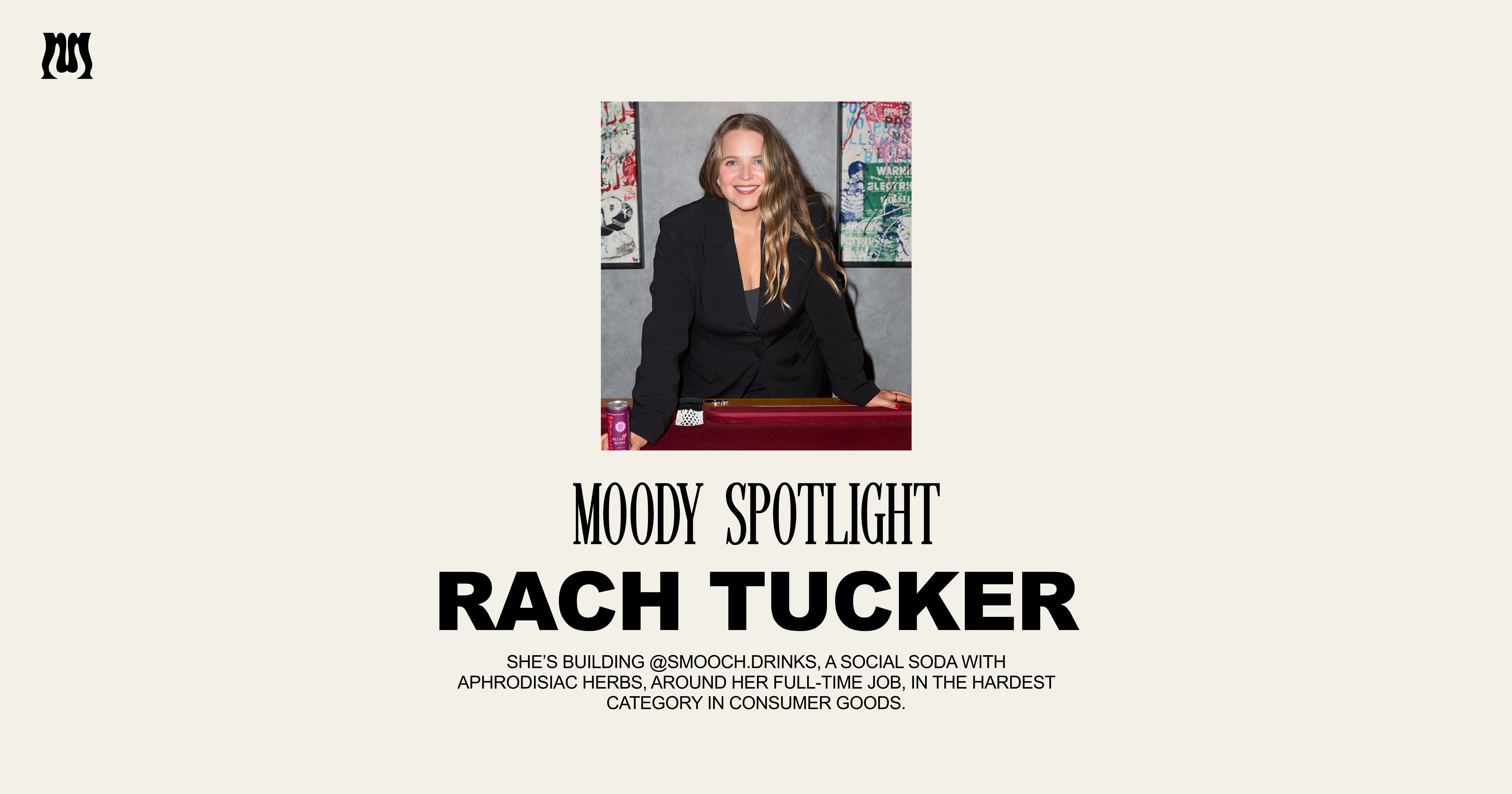
I asked Rach Tucker why she chose beverage. Of all the things a brand strategist with a full-time job could build, why the category with the worst odds, the ugliest working capital and the meanest shelf in the country.
“Naivety? Hahahaha! I wanted to build a brand I was proud of and a product I’d genuinely reach for. I’ve always been fascinated by pleasure, sexual wellness and beverage, and I saw a gap for something that sat between functional wellness and social ritual. Nothing was really owning mood, intimacy and connection. So naturally, I made 20,000 cans.”
So naturally.
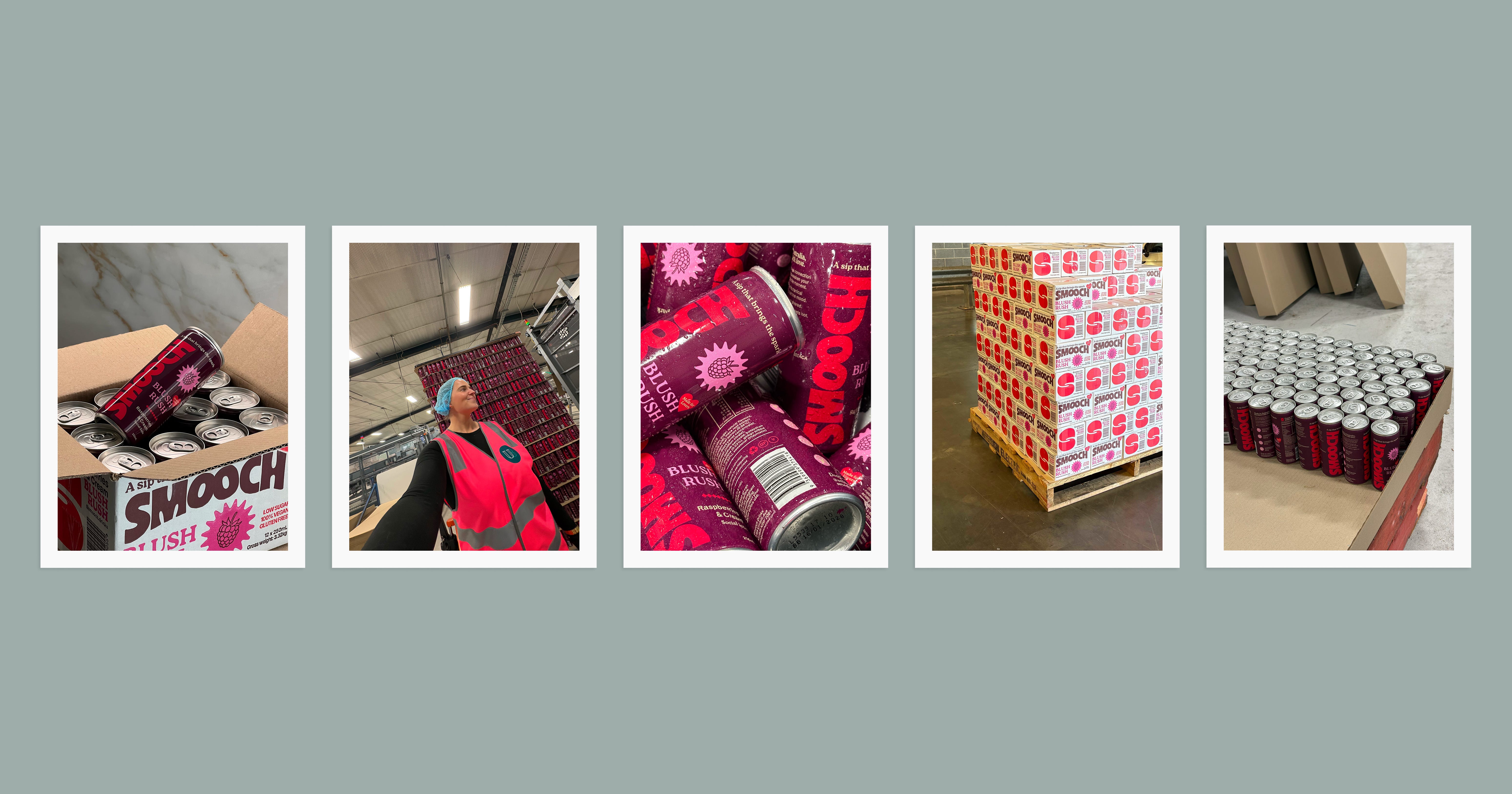
Twenty thousand cans. Imported actives, manufacturing, packaging, freight, all of it paid up front and sitting in a warehouse while she goes to her day job. Say that out loud and it sounds like a leap. Spend an hour on how she’s actually built this and it stops sounding like one.
Smooch is a social soda made with functional actives and aphrodisiac herbs. Sultry, moody, magnetic. A sip that brings the spark. Rach calls it “a functional drink, but also a ritual and a tool for connection”, and I want to spend this whole piece on why that second half of the sentence is the entire business.
Before any of the analysis, though, I should tell you how I know her.
Rach came to our February meetup and told me she was building a drink. Early R&D, nothing to show yet, just a clear idea and the nerve to say it out loud in a room of women she’d only just met. Then she did the part almost nobody does. She kept showing up. She used the network, asked for what she actually needed, and came back with something further along every time.
Six months later we were celebrating her launch at our Sydney launch party. We could not have been prouder.
If you want to know what a MOODY girl looks like in practice, that’s it. Not the launch. The turning up in between, for months, while it’s still just an idea and a spreadsheet.
01 — she killed her own best headline
Smooch didn’t start as a mood drink. It started as an arousal drink, which is a spicier, more clippable, more press-friendly thing to be. Rach walked away from it herself:
“Arousal was too tricky a promise. Every body is different, and there is no silver bullet. Smooch was always about creating the conditions for desire to spark. Mood is a clearer promise and a bigger opportunity. Smooch is about helping shift the energy. Feeling more present, playful, sexy and connected.”
Read that as a founder rather than a consumer. She had the louder claim in her hand and traded it for one she can actually deliver, before a single journalist made her.
That’s not a marketing decision. That’s a repeat-purchase decision, and repeat purchase is the whole game. NielsenIQ’s own BASES team went through more than 60,000 product innovations across five countries and found that just 52% of new items reaching national distribution are still growing sales in year two. Drop the distribution threshold to include everything launched and it falls to 33%. Two in three new products are already going backwards by their second birthday.
Which tells you what the buyer is actually watching. Not doors. Velocity. How fast the cans leave each fridge. They give you the shelf on a story and take it back on a number, usually inside one review cycle.
So the promise on the can has to survive contact with a real person on a real Tuesday night. Overclaim and you’ll sell the first one, because the first one is sold by the marketing. You only ever sell the second one if the drink did what you said it would.
Rach designed for the second can before she’d sold the first. Almost nobody does that. Most founders spend everything they have getting someone to try it once, then find out the hard way that trying it once was never the business.
02 — the graveyard and the gold rush, at the same time
Let’s not be precious. Beverage is brutal.
Tyler Dooley, who has built two drinks brands, put it to Inc like this: “For every one beverage brand that makes it, there’s nine others that are in the graveyard.”
It isn’t a small-brand problem either. Alex Cooper’s Unwell Beverages is winding up this month, less than two years after launching in partnership with Nestlé and with Target out front, while the day before that news broke the wider Unwell business took investment from Patrick Whitesell at a $500 million valuation. So this is not a company that ran out of money. This is a company with every advantage available looking at beverage and deciding it wasn’t worth the fridge space. I don’t read that as a failure of ambition. I read it as the category telling the truth about itself, loudly, in public.
Now the other half, because it’s why smart people keep doing this anyway.
PepsiCo acquired Poppi in 2025 for $1.95 billion, or $1.65 billion net of anticipated tax benefits, plus an earnout. A prebiotic soda. Olipop hit a $1.85 billion valuation in a Series C last February, having doubled sales to $400 million and turned profitable. Coca-Cola chose to build rather than buy and launched Simply Pop, its first prebiotic soda, into the same fight.
The no-and-low side is just as loud. Asahi has committed to a 20% sales composition ratio of non- and low-alcohol adult beverages within its major alcohol products by 2030. Diageo took a majority stake in Seedlip in 2019, fully acquired Ritual Zero Proof in 2024, and put €25 million into a dedicated Guinness 0.0 facility at St James’s Gate. Moët Hennessy took a minority stake in French Bloom. Molson Coors partnered with Naked Life, Australia’s biggest non-alc RTD cocktail brand, to take it into the US.
At home, IBISWorld has functional beverage production at $1.0 billion in 2025-26, up 12.3% in a single year, across 117 businesses.
→ So what: the buyers are real, they are shopping, and they are paying multiples that make the pain rational. But look at what they actually bought. Not one of those cheques was written for an audience. They were written for brands with velocity and an idea somebody else can’t just bolt onto an existing line.
03 — everyone built the substitute. rach built the occasion.
The Australian numbers are not subtle. AIHW has alcohol available for consumption at 9.8 litres of pure alcohol per person aged 15 and over in 2023-24, down from 10.5 the year before. That’s the biggest single-year drop since the collection started in 1960-61.
It’s generational, not a blip. Flinders University analysed more than two decades of data from over 23,000 Australians and found Gen Z are nearly twenty times more likely to choose not to drink than Baby Boomers, even after adjusting for sociodemographic factors. Circana has the share of Australians buying zero-alcohol versions more than doubling since August 2020, and non-alcoholic drinks adding $1.8 billion in sales over the past two years.
Almost everybody read that and built a substitute. Fake beer. Fake gin. The apology version of the thing you used to order, priced like the real one, drunk with a faint sense of loss.
Rach read it as an occasion:
“Drinking is inherently social and ritualistic. Whether it’s wine at dinner, tea and gossip, or a soda with someone you fancy. Smooch is powerful because it is built around that moment of connection, but one that is sexy, sultry, magnetic, a little moody. When people buy Smooch, they’re not just buying a drink. They’re buying into the idea that feeling good, feeling sexy and making space for connection is worth prioritising.”
That’s not a substitute, it’s a category. Hydration, where Unwell went, is the most crowded, most price-compared, most brand-agnostic shelf in the store. Mood, intimacy and connection has no incumbent, no giant defending it and no obvious Coca-Cola line extension waiting to squash it.
She also refuses to do the beachy sunny thing, which I love. Every functional drink in this country looks like a Bondi morning. Smooch looks like 9pm. When you’re the smallest brand in the fridge, distinctiveness is a distribution strategy.
04 — cash flow, and the two buyers who decide
I asked what a fortnight in had taught her that no amount of planning prepared her for.
“Cash flow. What the fuck.”
Correct. Beverage has the working capital profile of a mining project and the margin profile of a snack. You pay for all of it up front, then wait for a warehouse to slowly turn back into money.
The Australian shelf makes that harder. In its February 2025 supermarkets inquiry, the ACCC put Woolworths at 38% of national supermarket grocery sales and Coles at 29%, together roughly 67% of supermarket industry revenue, and called it “an oligopolistic market structure in which Coles and Woolworths have limited incentive to compete vigorously with each other on price.” Two buyers, two-thirds of the market. If both say no, there is no third door at scale, and a founder with 20,000 cans and a term of trade cannot wait out a category review.
So when Rach says the plan is independent grocers, hotels, bars and restaurants, that isn’t a cute starter strategy. It’s the only door in the building, and for a drink selling an occasion it’s the better one anyway. You want someone’s first Smooch to happen at a table with a person they fancy, not under fluorescent lighting next to the Powerade.
Right now it’s smoochdrinks.com and a select few Sydney stockists. Next is more doors, more fridges, more hands.
Ask most founders what they’re chasing and you get an adjective. Ask Rach and you get this:
“2,000 followers, 15 retail doors and 250 online orders by Summer.”
Three numbers and a deadline. That’s not a vibe, that’s a target you can be held to, and she said it out loud in public, which is the part most people won’t do.
rapid fire with rach
Because this series comes with a rapid fire round, and nobody leaves without doing it.
What’s the mood right now? “Hustle mood. We’re early, there’s momentum, and I’m determined not to waste it.” Pace, adrenaline, opportunity, figuring it out as she goes. Her word for it: “slightly addictive.”
Most unhinged thing you’ve done for the business? “Lie about my age and wear a ring on my ring finger. Sorrrrry, but sometimes you’ve gotta fake it to be taken seriously.”
What are ambitious women doing too much of, and not enough of? “We need to spend less time building in AI, and more time building in real life. AI can make us faster, but relationships take us further. Go to the lunch. Show up to the drinks. Meet the person. Trust is still the ultimate career accelerator, and you can’t prompt engineer it.”
Advice to yourself five years ago? “Success is infinite. Someone else winning doesn’t mean there’s less left for you. They rise, you rise.”
What do you want the MOODY girls to find you for? Brand strategy, creative thinking, and “the very unglamorous realities of building a CPG brand from scratch.” Selfishly, collaborations: pop-ups, events, creative partnerships, PR, retail introductions. “If our brands could make something more fun together, I want to hear about it.”
The one intro that changes your next 90 days? “Distributors. I’m looking for partners with strong relationships across both retail and foodservice who can help open the right doors. If you know one, send them my way.”
Where can we find you? Rach on LinkedIn. Smooch at @smooch.drinks and smoochdrinks.com.
so here’s where i’ve landed
The received wisdom is that beverage is won on reach. Get famous, get seen, get stocked. Reach is also the single easiest input in the whole model to buy, which is exactly why it decides nothing.
What can’t be bought is an occasion nobody owns and a promise you can actually keep. Rach has both, and she got them by making the unglamorous choice at every fork: kill the louder claim, take the harder doors, say the number out loud.
There’s a line of hers I keep coming back to. Less time building in AI, more time building in real life. You can’t prompt engineer trust. She’s selling a can designed to get two people to sit down together, which means the belief and the product are the same object. That is rarer than it sounds, and it’s usually the difference between a company and a range of flavours.
Twenty thousand cans is a terrifying amount of conviction for a woman doing this around a full-time job. It’s also the good kind of terrifying. She’s already ordered. Now she just has to be right, and she’s building like someone who intends to be.
In February she told a room she was going to do this. By August it existed. That’s the whole point of the room.
Go buy a can. They’re delicious. Better yet, send her a distributor.
Love Brooke x
MOODY is Australia’s answer to the serendipity Americans take for granted. The room where founders, operators, corporates and creatives are in the same group chat, and it turns out they needed each other. These are the girls who get it and we are in a MOOD.
This newsletter is the highlight reel. The WhatsApp is where we actually live.
Every city, growing weekly.
That’s on being a delusional diva with a mission! Beautifully written with such passion, insight and smart, as usual Brooke✨❤️💋