

Hi divas 🤍
I had six tabs open this week that I could not close, and somewhere around the fourth one it clicked. They’re all the same story wearing different outfits. Everyone is spending more and getting less, and we’ve all agreed to call it a good time.
A celebrity gadget that’s all casting, no product. A festival selling human connection while drowning in AI. A 188-year-old department store finally handing a woman the keys to fix what it broke. Two cool-girl brands rattling the tin for cash. A European resale giant that slipped into the country overnight. And a tax-time sale that looks like a party and feels like a budget meeting.
Six stories. None of them connect. Lined up, they tell you exactly where the consumer is right now. Let’s go.
1. Kylie put on the Meta glasses and I nearly bought a pair
Here’s the upsetting part. It worked on me.
I have never wanted smart glasses. Never added them to a cart, never thought they were cool, never once felt them enter the group chat. Then Meta dropped its new line this week, quietly scrubbed the Ray-Ban name off the whole thing, and put Kylie Jenner’s name on the hero pair. The Meta Glasses by Kylie land at AU$629, a clean $160 more than the other two models at AU$469. What’s the extra money for? Almost nothing you can use. A little gem on the lens, a nod to paparazzi flashes. Metal nose pads so your foundation survives. A sparkling chime when you put them on. Kylie’s actual voice as your AI, “rise and shine” included.
And there I was at 11pm, basket open. An hour no good decision has ever been made.
Because the casting is the whole product. The tech is the same kit that’s been sitting there unloved for two years. What changed is who’s wearing them. Kylie’s been on a run: the soft, “real” turn on Jake Shane’s Therapuss (Session 120, the most-streamed episode in the show’s history), the courtside silly-goose era with Chalamet, the slow reveal of an actual personality. The campaign landed on top of all that goodwill and it just worked. No other Kardashian name-slap is moving culture like this right now. Get the casting right and the product barely has to turn up.
Then I get off the bus. Because it’s surveillance tech with a gem on it. The loudest take online this week was that a camera that doesn’t look like a camera should probably be illegal, and they’re not wrong. We say we’re desperate for connection. For IRL. For putting the phone face-down at dinner like grown-ups. And the most desirable object of the week is one more pane of glass between you and the person across the table, quietly clocking everything.
It sold me a more elegant way to ghost the people I’m sitting with.
So what does it say about us that the hottest product of the week is a better-looking way to leave the room without standing up?
2. Why is everyone suddenly at Cannes
Cannes Lions used to be an industry thing. Agencies, ad men, rosé, rooms I had no real interest in. This year I could not stop thinking about it, and judging by my feed, neither could you.
More than 500 creators worked the Croisette, up from about 400 a year ago. Not the kids’ table “media channels” anymore. Strategic partners, with brands rebuilding the room to seat them.
But the glow-up has a crack right through it. Award entries fell roughly 25%, to 20,050 from 26,900. Leadership is calling it a “reset.” Generous. Last year, winning campaigns had their Lions stripped after agencies got caught using AI to fake the results. So the festival that just tightened its rules to punish AI deception threw its biggest-ever celebration of AI creative tools in the same week. Iconic, no notes.
Here’s the line that stuck. One agent remembered when spotting ad legend Martin Sorrell on the street was the celebrity moment at Cannes. That was the old power map: agencies, networks, holding-company chiefs. This year the room belongs to the people who walk in with the audience already attached, a community, a production style, proof people choose to watch them with no media plan forcing it. The power didn’t shift. It flipped.
Before you throw the parade, though, read what the creators actually said. One told the Washington Post his first Cannes felt like an “I made it” moment, then went honest: “I didn’t feel welcome, to be honest.” Cut in line, talked over, treated like a second-class attendee. So here’s the bit nobody says on a panel: the CMOs want the meeting, and the old guard still resents the dollars walking out the door with people who never paid their dues at an agency. Both things. Same beach.
And the detail I keep turning over. In a week absolutely marinating in AI, the rooms that were actually alive were full of creators talking about human connection, real storytelling, getting offline. The main stage sells automation. The crowds show up for the opposite. The smart brands clocked why: a creator partnership that reads as a cash grab or an audience rental now just fails. Authenticity stopped being the nice-to-have. It became the product.
Want proof of where the money’s going? It wasn’t a keynote. It was a handbag. Balenciaga used Cannes to become the first luxury house to join Substack’s new sponsorship program, sitting in the launch cohort next to Uber, T-Mobile and Polymarket, sealed with a literary panel at its Cannes flagship. Read that again. A century-old fashion house decided the place to plant its flag in 2026 is independent writers’ inboxes. Not a feed. Not a billboard. Not a sixty-second pre-roll. Influence moved from the algorithm to the email.
This is the bit I actually care about, so I’ll say it straight. The program lets creators with as few as 100 paid subscribers tap those same advertisers directly. One hundred. Brand money that used to need an agency, a manager and a media kit is now reachable by a girl writing to a few hundred people who actually read her. That’s the whole game changing. The gatekeepers didn’t open the gate. Someone built a new door.
So is this the creator economy’s victory lap, or the most expensive room in the world to stand in, get cut in line, and insist that human connection still matters?
3. David Jones got a woman at the helm. Only took 188 years.
Erica Berchtold is the first female CEO in David Jones’ 188-year history. A department store whose whole reason for existing is the woman with the credit card, and it took until 2026 to let one drive. That’s a headline on its own. But the better story is her CV.
Berchtold ran THE ICONIC and was MD of Rebel Sport. A digital and e-commerce operator to the bone, handed the most analog format in retail at its most fragile moment. David Jones posted a $95.5 million pre-tax loss last year, sales down 8.7% to $2 billion, and her predecessor was shown the door under cover of a “planned transition.” Now she’s running the five-year INSPIRE30 turnaround: efficiency, margin, digital. A pure-play native, inheriting the cathedral.
Here’s where I get personal, because I live in the gap she’s been hired to close. The flagships are genuinely lovely now. Sydney, Melbourne, the level-seven shoe floor. Proof the in-store bet can work. But that is not the everyday David Jones. The everyday one is me walking into Queens Plaza and finding broken change rooms, nobody on the floor to grab me a size, nowhere to actually pay. The basics. Fumbled, by one of the biggest names in the country. You can refurbish a flagship until it glows. But if the local store can’t find me a size 8, the transformation is just a press release.
And she’s inheriting all this as the sector turns into a beauty arms race. Myer is going all-in, doubling its beauty offer, turning the halls into “worlds,” stacking up La Mer, Guerlain, Helena Rubinstein, chasing K-beauty and TikTok ranges to pull the younger shopper it admits it doesn’t have. Looks airtight. Then you check the maths. Only about 13% of beauty sales here happen online; 87% are still in a store, which is exactly why everyone’s racing into bricks and mortar. Yet Sephora, after all these years, sits at roughly 4% of online share. Mecca leads. Adore holds about 10%, and Adore is mid-rollout to 25 stores on about 2% margins, with a share price that’s slid from a $6.91 listing to around 36c. Big land grab. Brutal economics.
My first job was at Myer. The basement, youth fashion. I thought it was the coolest place a person could work. We didn’t have to wear Myer black, we wore our own jeans, and we’d burn mix CDs at home to play over the store stereo. The whole floor had a feeling. Mid-2000s, sure, and I was a teenager who thought a lot of things were cool. But it had something you cannot print on a planogram.
Berchtold can fix the tech. Myer can buy every luxury skincare house on the planet. But the real question for both is the one nobody wants to say out loud on an investor call. Can you merchandise your way back to cool? Or is cool the one thing a department store can never put on the shelf?
4. The DTC darlings go looking for money
Two of the most-watched direct-to-consumer brands went looking for money this week. Side by side, they’re a referendum on whether “born online and impossibly cool” still counts for anything once Wall Street walks in with a spreadsheet.
Reformation filed for an IPO, heading to the NYSE as REF. The numbers are hot: $507.1 million in revenue last year, up 15.7%, 20 straight quarters of double-digit growth, about 90% of it direct. That’s a real business. Not a vibe. But the profit line whispers the other half, net income more than halved, to $12.6 million from $32.6 million. It’s private-equity owned, and the filing opens with the brand’s signature wink (”Being naked is the #1 most sustainable option. We’re #2.”) before getting deadly serious about margins. The test: does the market still have an appetite for premium fashion that built its cool first and is only now sending the bill?
Glossier, meanwhile, the original DTC sweetheart, raised fresh capital to fund “the next chapter of Glossier’s growth” and said almost nothing about what that chapter is. Which is the tell. Glossier was built on scarcity, community and one very specific shade of pink. Needing a top-up, and being coy about why, is a long way from the brand that had people queuing round the block for a cleanser in a pretty pouch.
Put them next to section three and the irony pours itself. Reformation and Glossier conjured cult cool out of nothing and now have to turn it into the kind of growth investors can model. David Jones and Myer have the scale, the floor space, the foot traffic, and are trying to buy that cool back.
Here’s my flag in the ground. Turning cool into profit is the easier trick. Reformation just proved it. 20 quarters. Cool comes with attention, and attention is the hardest thing in retail to manufacture. You can always staff a model better, tighten a supply chain, raise a price. What you cannot do is reverse-engineer the feeling that made someone queue. So I’d take the brand with the cool and the cash-flow problem over the institution with the balance sheet and the empty change room. Every time.
So which is the harder trick in 2026, turning cool into profit, or turning profit into cool?
5. Vinted quietly landed in Australia
No press release. No launch party. Just a live website and an App Store listing that turned up this week, ahead of the official July 1 start. Vinted, Europe’s recommerce giant, valued at €8 billion, is now trading here. Pointed straight at eBay and Depop.
The model is the hook. Sellers list for free, print a prepaid label, keep 100% of what they earn. The fee sits with the buyer. That’s the same structure that’s already forced eBay to drop private-seller fees market by market. But the smart bit is the exclusive three-year deal with Australia Post, parcel lockers, post offices, the lot. It fixes the one thing peer-to-peer resale always breaks on. Shipping that doesn’t make you want to give up.
And the timing is everything. 46% of Australians already buy second-hand every year, and the local recommerce market is tipped to hit US$6.75 billion by 2029. Read that against everything above. A department store fighting to stay relevant. A beauty arms race. A consumer trading down. Recommerce just stopped being a side hustle and became a channel with national infrastructure behind it.
So when the cheapest, coolest wardrobe in the country is everybody else’s wardrobe, what is full-price retail even competing against?
6. Tax-time sales: everyone’s spending, nobody’s enjoying it
Here’s the tell of 2026. The sale still works. The shopper just doesn’t trust it anymore. She buys, then feels weird about it.
EOFY is one of our biggest retail moments of the year, and it’s set to grow a limp 1.9%, below inflation. About 6.1 million Australians will shop, but the share planning to spend less jumped six points, and around three million who shopped last year are sitting this one out. The clearest signal is generational: the 35-to-49s plan to spend $1,464, less than both the under-35s ($1,946) and the over-50s ($1,993). The middle is the most scared, because the middle is the most exposed. That’s your K-shaped consumer in one line. The backdrop confirms it: Deloitte has discretionary spending growth collapsing from 2.5% to 0.7%.
Same anxiety in the US, different accent. Amazon stretched Prime Day to four days and it’s headed for a record, $26 billion, bigger than Black Friday and Cyber Monday combined. Yet the average order fell 17%, to $48.36. Bigger event. Smaller baskets. Fortune called it the institutionalisation of the panic-buy. The deals are thinner, people buy anyway, and more of it goes on Buy Now, Pay Later (about 44% of Gen Z).
Everywhere you look, the same split. Record headlines, shrinking receipts. We’ve trained a whole generation to never pay full price, and to only move when they’re scared prices will rise. Which works, right up until the discount stops feeling special.
Look no further than David Jones this week. Up to 50% off, plus an extra 20% off designer, with an extra 50% stacked on some categories. Not one discount. A discount on a discount. When half price has stopped moving stock on its own, the baseline has already broken.
So what happens to retail in this country the day the sale stops working?
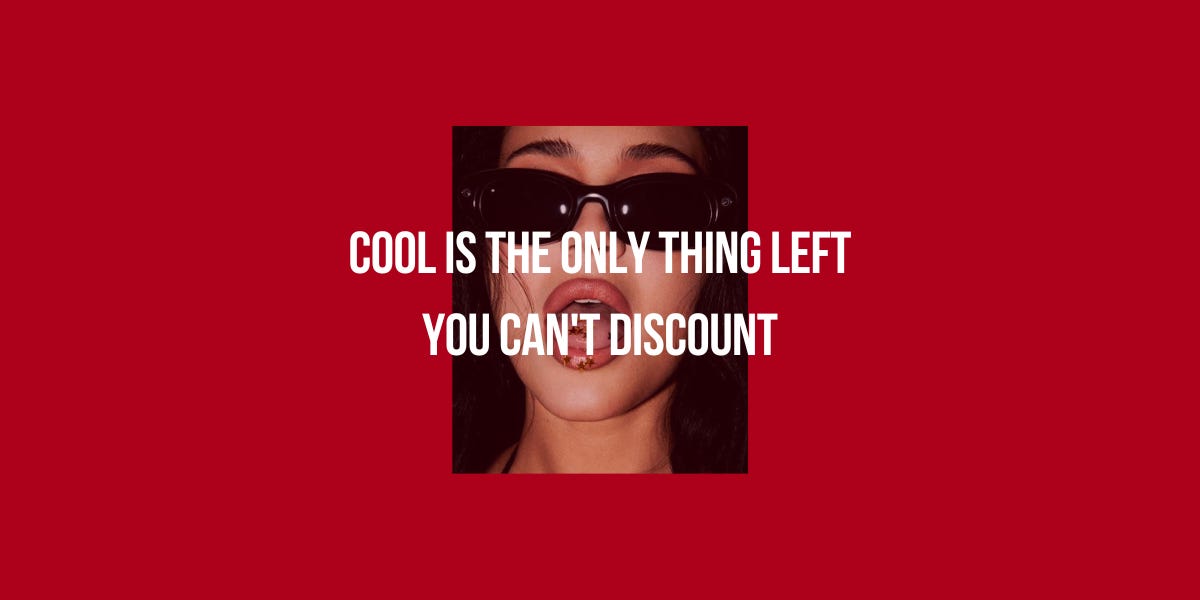
If there’s a through-line, it’s this: cool is the only thing left that can’t be discounted, faked, or bought back. Everything else is on sale.
Which one are you still chewing on? Reply, I want to know.
Brooke x
The chokehold those Kylie Glasses have on me. Can I plz have a pair WITHOUT the surveillance device?