

Let me say the nice part first, because I mean it.
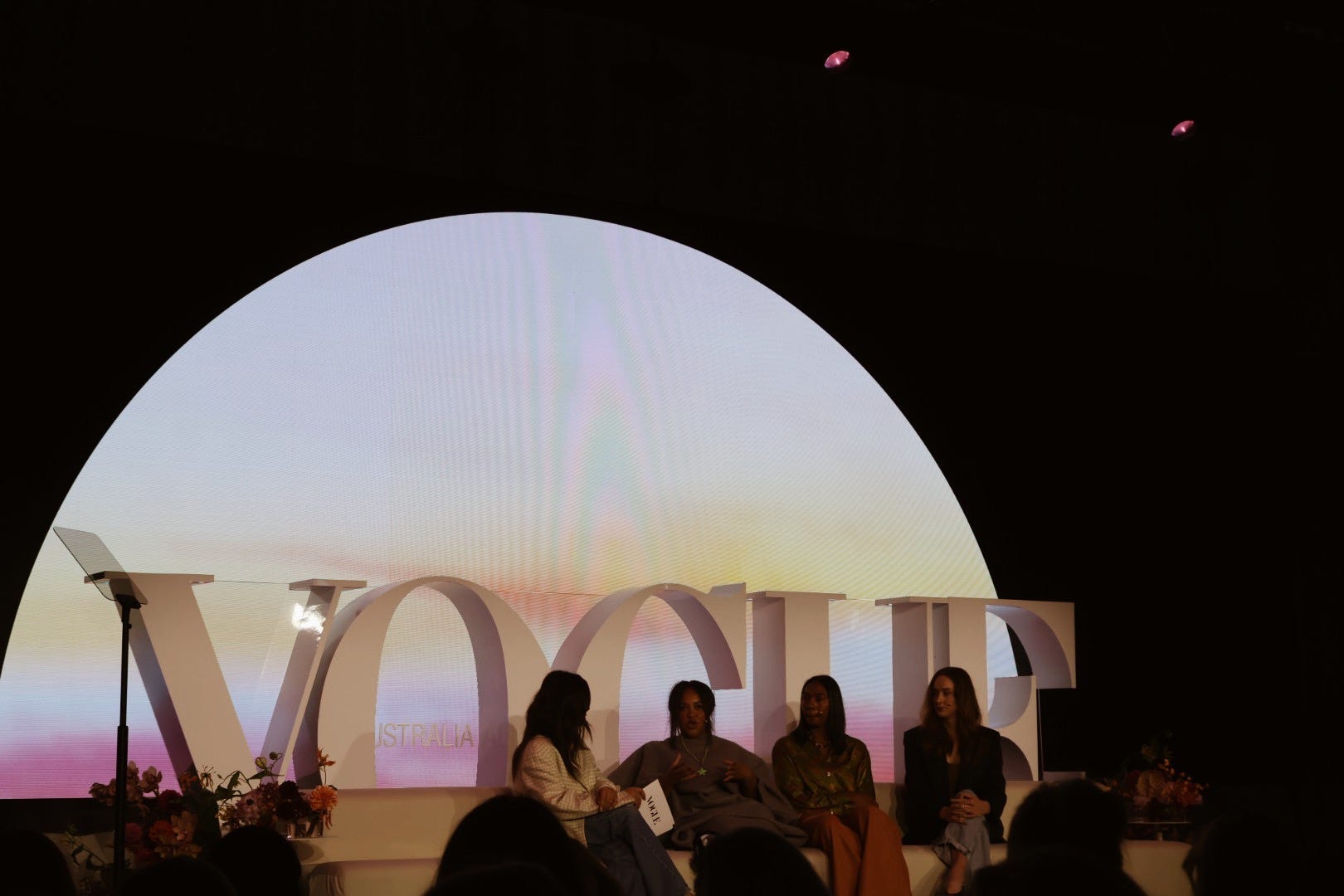
Any excuse to be in a room full of ambitious Australian women is my actual joy in life. It’s the whole reason Aussie Angels exists. So Saturday at Vogue Codes was always going to be a good day for me. The room was beautiful, the speakers were genuinely brilliant, the energy was unmatched, and I left with a gift bag I needed a forklift to carry. Eleven years in, the fact that this event exists at all, that Vogue has spent a decade insisting women belong at the centre of the tech conversation, is a real achievement and I don’t take it for granted.
And. (You knew there was an and.)
I left a little frustrated. Not because the day was bad, but because it was so close to being extraordinary, and I think the women in that room could have handled, and deserved, more. So in the spirit of loving something enough to give it real feedback rather than a polite clap, here are my notes. Vogue, if you’re reading, I am sticking my hand up to help curate next year. More on that later.
Note one: twenty minutes is not a panel, it’s a trailer
Here was the format for most of the day. Three extraordinary speakers, one moderator, two questions each, twenty minutes total. Run the numbers. By the time everyone’s been introduced with the multi-hyphenate biographies they’ve absolutely earned, you have maybe ten real minutes of conversation, split three ways.
That’s not enough time to get anywhere good. You get the headline and the applause line, and then the moderator has to wrap because the clock’s already gone. You never reach the specificity, the how, the part where someone actually teaches you something you can use on Monday.
And when the timing slips, it slips unevenly. In the Big Tech panel, Laura Henshaw, who was excellent, spoke for a good chunk of the slot before the other two panelists had properly been brought in. I’m not mad at Laura. She was great. I’m mad at the container. Three women that good should never be fighting each other for oxygen inside a slot that short.
The fix is not complicated. Fewer panels, longer. Two questions becomes five. Give a brilliant woman thirty-five minutes and she’ll change how you think. Give her twenty and she’ll give you a soundbite. We came for more than soundbites.
Note two: “humanity first” is lovely, but it let us off the hook
The whole day ran on a humanity-first thesis. Slow down. Touch grass. Make things with your hands. Your taste is your own. Protect your nervous system from the algorithm. And look, I agree with almost all of it. The ancestral knowledge panel was my favourite of the day and I’ll defend the cortisol stats from the Unyoked CMO to anyone. (Twenty minutes in nature drops your cortisol by twenty percent. Two nights off grid beats yoga, meditation and CBT by fifty percent. Genuinely useful.)
But here’s my problem. A room full of ambitious women, many of them in tech, retail, media and STEM, gathered at a tech summit, and we spent most of the day being gently reassured that the human stuff still matters. Of course it matters. Nobody in that room needed convincing that they’re a person.
And before anyone reads this as anti-humanity: it isn’t. The human stuff is literally my whole thing. I build community for ambitious women for a living; connection is the soul of everything I do. But that’s exactly why I want more for them. When you get a room of women this capable together this rarely, you owe them more than reassurance.
What we didn’t get was the part where we face into the tech and actually skill up. We talked about AI mostly as a thing to be wary of. Bias in, bias out, true and important. But we barely touched what’s actually coming, or how a woman in that room could use it, build with it, or position her career and her business around it.
We barely touched the word “agentic” all day. Not the AI agents that are about to do real work on our behalf, not what they mean for our jobs, not agentic commerce reshaping how every brand reaches a customer. The single biggest shift in how technology will move through our lives, and at a summit about the future, hosted by Vogue, in 2026, it was essentially absent.
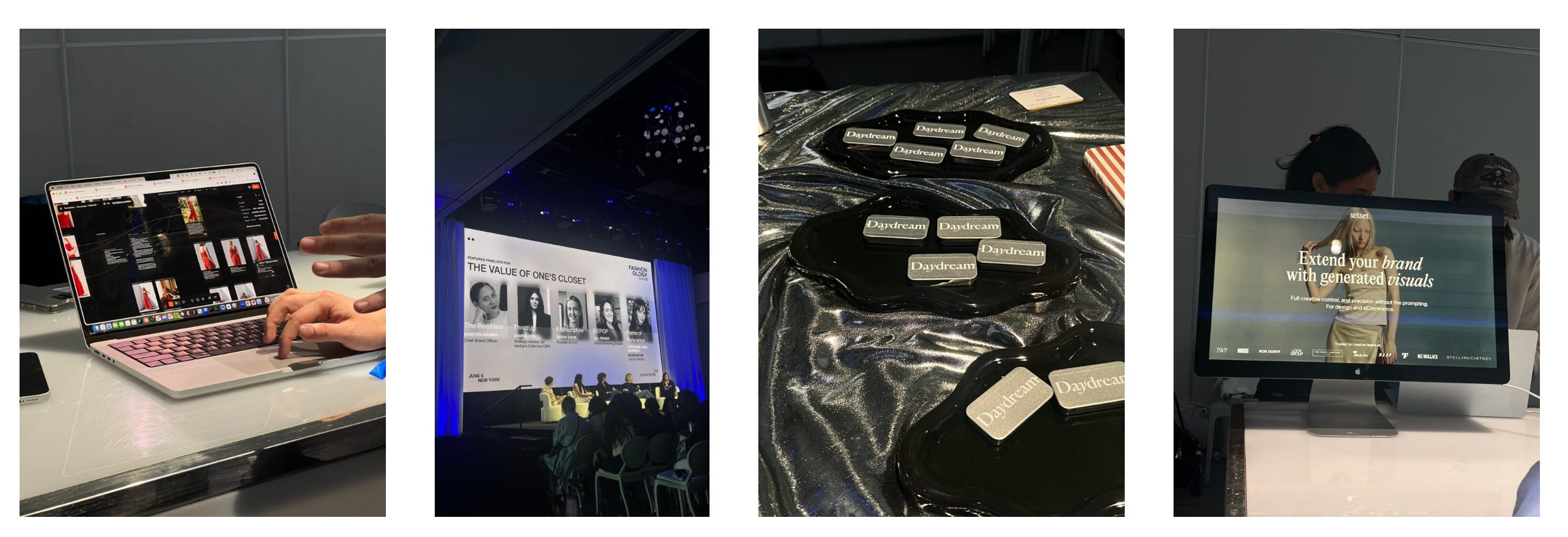
Meanwhile, the week before, in New York, Mary Korlin-Downs (the self-described Anna Wintour of fashion tech, and honestly the title fits) ran the FASHIONOLOGY Summit with All Things Fashion Tech. Fourteen hundred people. Nine panels. The lineup, just so you feel it: trend forecasting and data, agentic commerce, virtual try-on, the creator economy, wearables, material innovation, and fashion tech investment. A scent salon and a wearables showcase as activations. That is what facing into the tech looks like. That is a room walking out with new language, new contacts, and a map of where the industry is actually going. I almost flew to NYC for it and I regret not.
And the news she’s covering right now is the exact conversation we should have been having. Sephora is partnering with Google so you can research, build a basket and check out inside an LLM, because that’s where discovery is moving. OTB, the group behind Diesel and Margiela, is doing AI try-on with Google Cloud. ZyG just raised sixty million to scale an agentic ecommerce operating system. This is happening now, to fashion and retail specifically, and it is going to reshape how every brand in that Vogue room reaches a customer.
Here’s the part that really got me, and I’ll declare my interest because I work at AWS, so this is my actual day job. Three weeks before Vogue Codes, AWS launched the Agentic Shopping Assistant, which lets a retailer stand up its own branded AI shopping agent in about sixty days instead of building it from scratch over years. The flagship example? The Kate Spade AI Gift Concierge, built by Tapestry, which guides a shopper to the right gift in conversation. That is fashion x tech. That is a handbag brand running a production AI agent, live, right now. Accenture reckons more than thirty percent of online commerce could run through AI agents by 2030, somewhere around 3.1 trillion dollars in transactions. So we had, in one Sydney room, a few hundred of the exact women who are going to have to navigate that shift in their careers and their businesses, and we spent the day talking about whether the algorithm is bad for our nervous systems. Both things can be true. But only one of them sends you home able to do something on Monday.
Vogue x fashion tech should be the easiest, most obvious, most powerful version of this event. The audience is right there. The cultural authority is right there. We could own this conversation in this region the way nobody else can. We just have to be brave enough to go deeper than “slow down and touch grass.”
And the moment that summed up the whole miss: Arms Rosenberg, who has built a global fund run by AI agents trained on her own brain, sat on stage and let investing get waved off as “boring,” just spreadsheets and data. I sat there a little stunned. Investing is not boring. Investing is the single most direct mechanism women have to build actual power, the thing every other panel that day was quietly begging for. We talked about closing the women’s health gap, paying female athletes properly, getting women into the rooms where systems get built. All of it runs on capital. All of it runs on women owning assets and compounding them.
Calling that “boring” in a room full of ambitious women is the problem in miniature: we reached for the relatable, self-deprecating framing when we could have taught the room how to actually do the thing. Arms could have spent twenty minutes on how she thinks about conviction and risk and price targets, and we’d have walked out richer, literally. Instead we got “it’s just data.” That depth was right there, and we left it on the table.
Note three (a brief intermission for the funniest moment of the day)
The Qantas panel, on the psychology of the twenty-plus-hour Project Sunrise flights, was genuinely interesting. Human-centred design, lighting that mirrors your destination so a sunrise rolls from the front of the plane to the back, ten years of research with the Charles Perkins Centre. Cool stuff.
But I will be thinking until I die about the bit where they proudly unveiled, as a design innovation, a “wellbeing zone” so that economy passengers can stand up and move around. The only airline in the world to specifically design a space where the people in economy are allowed to have a body. Girl. That’s an aisle. We’ve reinvented the aisle and put it in a deck. I laughed. I’m still laughing. Iconic, no notes.
What we did cover, and what was actually great
I don’t want the notes to drown out the wins, because there were real ones. The highlights, in scannable form:
On the medical panel (the best content of the day): Professor Kate Drummond’s case for fixing a male-default profession without dropping a single standard is the cleanest I’ve heard. Define the real minimum bar, then actively favour the women who clear it until the culture changes. She’s doing it in neurosurgery right now, because the alternative is waiting two hundred years for equity. Two hundred.
On the women’s health gap: Lydia O’Donnell’s stat that only six percent of sports science research is done exclusively on women explains roughly everything about why we’ve all been training on a men’s plan with the hormones deleted. And the line every founder should pin to the wall: every dollar put into closing the women’s health gap returns three. It’s not charity, it’s the most underpriced market going.
On AI and bias (Dr Amandeep Hansra): train AI on history and you don’t fix bias, you automate it at scale. A heart attack presents differently in women, but the models learned the male version. Sixty percent of women’s-health answers from the top AI tools came back wrong. The only fix is women in the room building the thing, which is exactly the argument for a day like this existing. I just wish we’d spent more time on how to actually get into those rooms.
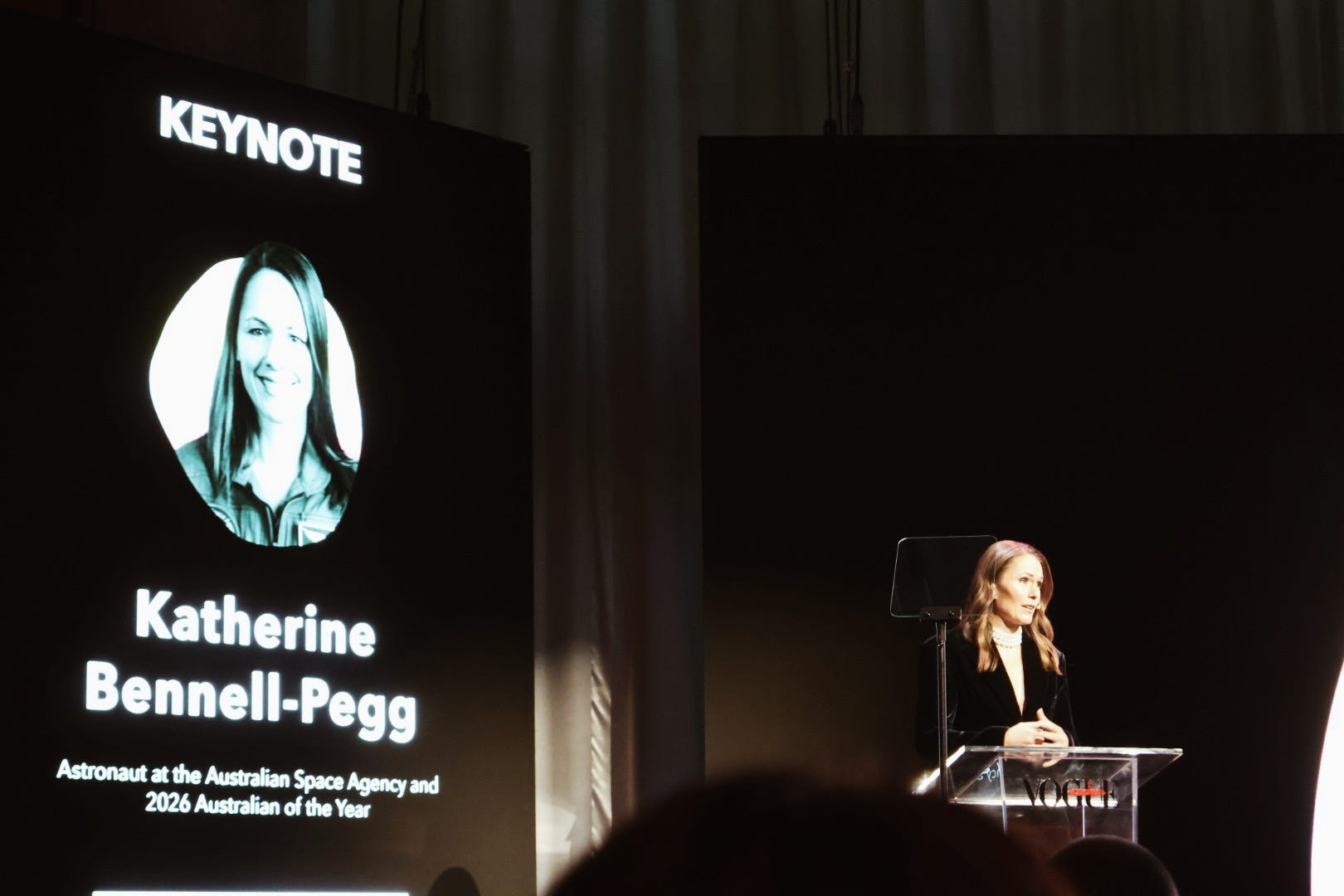
On the astronaut (Catherine Bennell-Pegg): until 1966 women in the Australian public service had to resign when they married. Banks wouldn’t give a woman a loan without a male guarantor until the seventies. But we put men on the moon in 1969. We could leave the planet before a woman could open a bank account on her own. Her reframe of the old line is the thing I wrote down twice: we say you can’t be what you can’t see, and she added, you can’t be what you can’t see yourself being. Fewer than four percent of engineers in Australia are Australian-born women. We are, in her words, leaving too much talent on the launch pad.
On ancestral knowledge: Maeva Heim of Bread Beauty said the thing I’m still turning over: the value of making things with your hands, the one skill AI can’t touch, and how that human craft gets more valuable as the world automates, not less. It flips the AI-doom framing on its head, the most human things you can do become your edge. A genuinely great idea, and I’ll be honest, also a comfortable one for a tech summit to land on. I wanted the panel pushed one step further: okay, so how does a founder actually price and protect that human value when the machines are this good?
That’s the follow-up we ran out of time for. And Liandra Gaykamangu of LIANDRA gently dismantled the whole morning by noting we’d spent hours talking about going to space to save the Earth, when Earth is already great, and maybe the constant push to be the best, the most, the fastest is the actual problem. Indigenous knowledge has held “by less, but better” for tens of thousands of years. Fashion’s discovering it this season and calling it new.
On money: Lucy Kough of Tap the Gap said start now, because time is the only ingredient you can’t buy back. Super compounds like a snowball, and a third of Australians have never once checked one of the biggest investments they’ll ever own.
On work: work is a mindset now, not a place, with three in four people already working across multiple locations. And the people hiring aren’t buying technical skills, they’re buying mindset: curious, adaptable, willing to back yourself. The TechnologyOne leader who said it traced her own adaptability to a childhood spent constantly moving, always the new girl. The thing you think is your messy backstory is often the exact thing that makes you hireable.
On founders: the angel investor’s filter for whether to back someone, are you real or performative, grounded in three things. Execution: do you have a product and talk to customers, or just a beautiful story? Feedback: when she gives you a note, do you act on it? Iteration: are you making the thing better than yesterday? She’ll watch a founder for months before writing a cheque. It’s a sharp filter to turn on yourself, too.
On AI, the reframe that stuck: Arms again, with the most useful answer to AI anxiety I heard all day. Her agents aren’t replacing her, they are her, accelerated: four decades of investing experience built into the system with her judgment at the core. The AI doesn’t sideline her expertise, it scales it. Which is the thing the whole day kept circling. Train AI on the male default and you automate the male default. Build it with women in control and it’s just leverage. So the better question isn’t “will AI take my job,” it’s “how do I make it an extension of my own brain before someone else’s becomes the default.”
That, right there, is the conversation I wanted the whole day to be. Who’s holding the pen, and how do you, woman in row 14, get your hands on it.
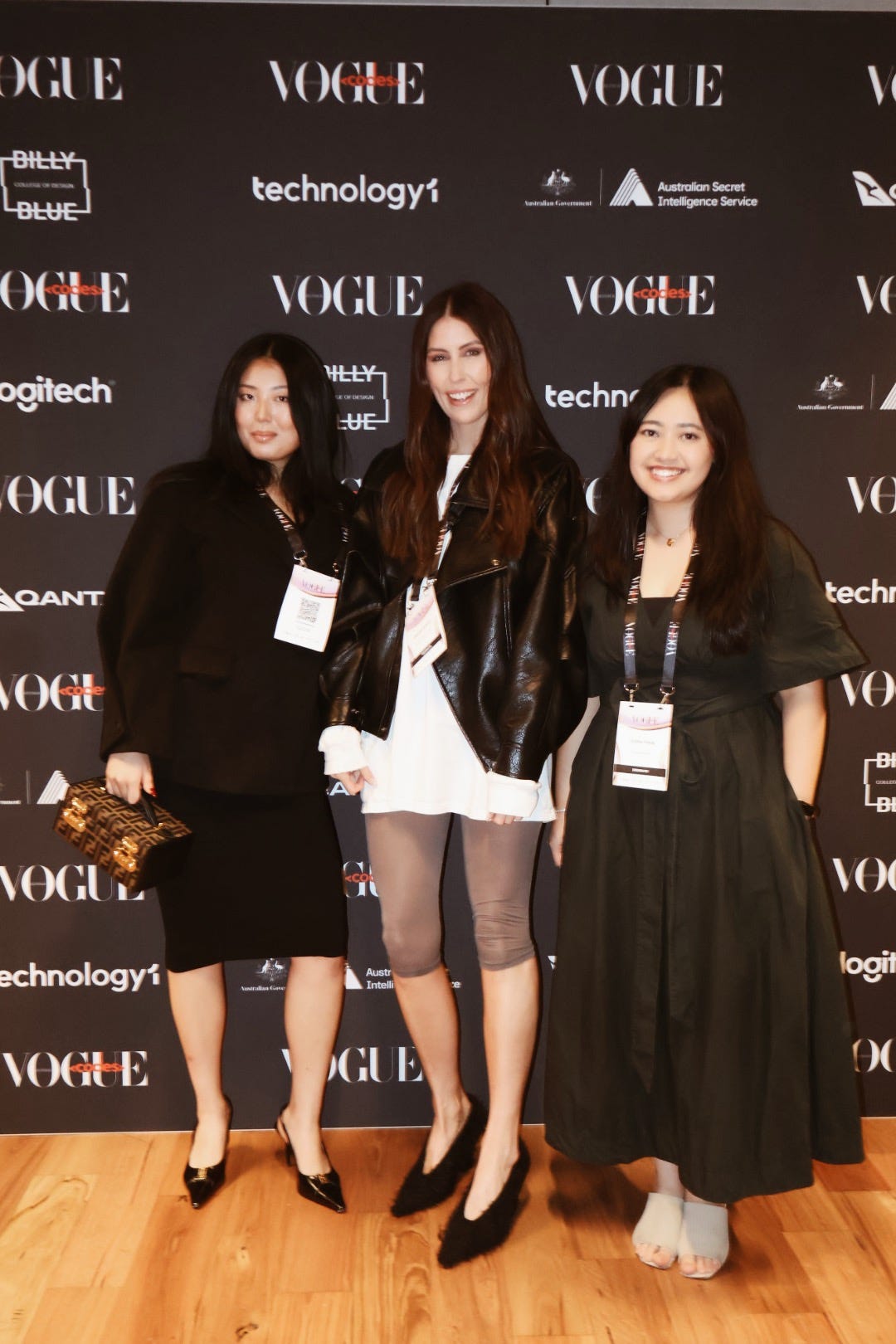
So here’s my pitch
I went to 3 large enterprise tech events last month and walked out thinking about a different gap. The rooms skewed heavily male, and for all the brilliant content, it wasn’t really designed to feel like an open door for the every girl just finding her way into this world. That’s not unique to one event; it’s most of the industry. And I say it as someone who loves this stuff and builds in it for a living: we have a long way to go on making these rooms feel like they’re for her too.
A month later I’m at Vogue Codes, which is the opposite room, full of exactly the women enterprise tech struggles to reach, and yet the conversation still didn’t quite hit the level I know it could. One kind of room has the access but not the audience. The other has the audience but doesn’t always push it. The summit that nails both, that gets the every girl in the room and sends her home able to talk about agentic AI like she owns it, doesn’t really exist here yet.It should. And it could be this one.
So Vogue, genuinely: call me. Let me help curate next year. Longer panels. Fewer of them. A real strand on what’s coming in retail and commerce and AI, taught in a way that makes a woman feel powerful rather than warned. Keep the humanity, it’s the soul of the thing, but pair it with capability so we walk out upskilled, not just inspired.
Because the women in that room already get it. That was never the question. The question is whether we’re going to hand them the soundbite or the toolkit.
Give them the toolkit. They’ll build the rest.
— Brooke x
A perfect summation of the day. It was a nice day, not an awe-inspiring day. I agree that we were two questions off getting into the nitty gritty.
Also, I want to see some case studies! Similar to the large tech conferences - one room with multiple activations you can tune in with headphones. Recommend having breakout spaces in the foyer mixing zone where new startups/ people harnessing new tech can showcase their work and talk through actual case studies.
What about pairing the vogue codes summit with a pitch night where there is a grant for investment and/ or mentorship - you stay for the final unveiling.
Great article! I wasn’t surprised when Armina called investing “boring” when addressing the audience I think it’s a reflex that women in finance do when we address people who aren’t in the industry because the perception is that talking about numbers is “boring” which is a shame because talking about numbers and being comfortable with financial topics is a powerful way for women to be empowered and take charge of their lives.
Also it’s such a shame she said her case study was boring because if I recall she was talking about knowing when to invest in one company because she noticed it was on the same growth trajectory of another successful company that’s already matured. This isn’t a boring case study, this is a great insight into how investors think and something everyone can take notes.