
MOODY SPOTLIGHT, the interview edition. You know girl of the week, where you meet the girl. This is where we open the books: one woman, one real business decision, and the actual mechanics of how she made it. This week: Amy Ross, founder of By Limen.
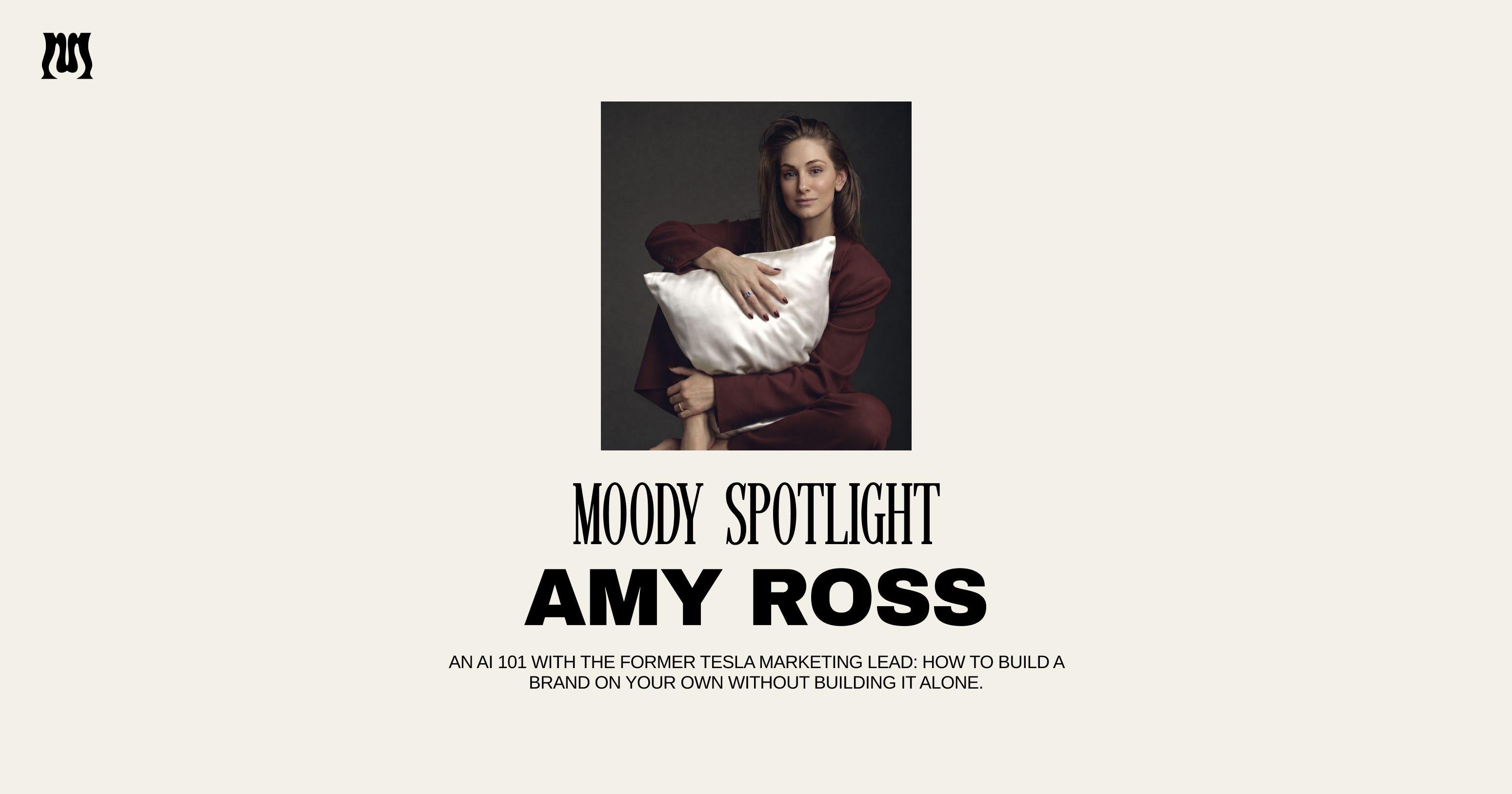
by limen, at a glance
→ The brand: By Limen, a skincare-adjacent beauty brand designed in Melbourne that looks beyond the bottle to the things your skin touches.
→ The founder: Amy Ross. Sixteen years building brands for other people, from advertising agencies to more than five years at Tesla, where she ultimately led marketing and growth across APAC, to Head of Brand at The Oodie.
→ What they make: Pillow By Limen, a copper-infused, 22 momme, Grade 6A mulberry silk pillowcase. Or as Amy calls it, lingerie for your bed.
→ The proof: Started as a dare: thirty days, $5,000, no team. Named a finalist for Product of the Year at the Beauty Industry Celebration Awards five weeks after launch.
“What are you sleeping on?”
That’s what Amy Ross’s dermatologist asked when she came in with red, irritated skin, and Amy was almost offended. Vintage French linen, four hundred dollars a pillowcase. Clearly she’d nailed that part. She hadn’t. “I was putting so much thought and money into what went on my face, but I’d never questioned what it spent every night pressed against.”
Why a pillowcase, of all things? “Because it’s such an intimate object and yet we treat it like decoration.” At a dinner party recently, someone reacted to the topic with polite boredom, “and that thrilled me. It meant there was something hiding in plain sight.”
She’s right, by the way. We’ve branded the morning routine, the commute, the workout and the wind-down, but the eight hours we spend face down are still a cotton free-for-all. “I didn’t want to make another serum,” Amy says. “I wanted to bring that same attention to the things touching our skin.”
The business decision I wanted to open the books on is how she built it: on her own, on a brief no client would ever sign off, with AI doing the jobs she used to hand to a team, and a set of agents whose whole job is to tell her when she’s wrong.
I met Amy in Singapore at NRF APAC, through a friend of a friend, which is the most MOODY way to meet anyone. I’ve been watching what she’s building ever since.
01 — make the constraint the brief
It started with a dare to herself: could she build a business in thirty days, with $5,000, just her and AI?
She’d spent almost sixteen years making people look twice at things they thought they already understood. “It didn’t have to be a big, sexy category. Finding something interesting in an overlooked one was often more satisfying.” AI made backing her own idea feel achievable, so she went straight back to being a student, signing up for courses and disappearing down tutorial rabbit holes. “I had enough experience to give the idea a serious go, and I was still hungry enough to start from the beginning.”
With that little time and money there was no way to brief her way around anything she hadn’t done before, so she had to learn it. The biggest line item it killed was creative production. Two years ago, bringing the world in her head to life would have meant a creative team, then a producer, photographer, stylist, hair and make-up. “That’s a lot of people and budget before you have a single asset.” Now she shoots the product on her phone at home and uses AI to build the environment around it, while still making the mood board, writing the art direction and assembling every final piece herself.
“The brief hasn’t disappeared. I’m giving it to a different collaborator.”
The website went the same way. Every template felt like a compromise. “I could see it in my head. I just couldn’t find the version you could click ‘buy’ on.” The old version of this story ends with a brief to a designer and a developer. Instead she did a Claude Code course and built the site herself in about a week. “After years of briefing other people, there’s something quite addictive about getting closer to the making. You can try something, see how it feels and work out what needs to change.” Her rule now: “If the template doesn’t fit the vision, I want to know enough to change the template.”
She’s quick to say none of this is a shortcut. “You cannot offload creative and critical thinking and expect something interesting back. I have to know what I’m trying to make and keep pushing towards it.”
What the maths really bought her was permission to be wrong. If she spends three days on an idea that goes nowhere, she’s lost “time and tokens, rather than tens of thousands of dollars.” Most first-time founders are too scared of wasting money to try anything interesting. Amy made a bad idea almost free, so she could afford to have lots of them. “That freedom makes me more decisive, more curious and much more willing to take a creative risk.”
→ So what: before you hire for a gap, find out whether you can close it yourself first. Even if you hire later, you’ll write a far better brief.
02 — build the colleagues who tell you no
The thing Amy misses most about big business is the people, and specifically the moment when someone sees the thing you missed. Working alone, she says, “can involve a very convincing discussion in which every participant is you. Some days I’m basically that Spider-Man meme, pointing at myself.”
So she built the colleagues. “I don’t need nine versions of ‘Well done, Amy.’ I need questions, different perspectives and someone calling my bluff.” Here’s how her setup works:
One agent per seat. Nine agents, each responsible for a different part of the business, including finance and operations.
Briefed to push back. Each is set up to ask the questions a real person in that role would ask, not to agree with her.
Brought in at both ends. At the start of a piece of work she gets them to throw her a provocative question, “so I don’t keep producing variations of my own favourite idea.” At the end they help refine and finish.
The final call stays human. She still has a real accountant, and every decision is hers.
The best example is her “CFO.” Amy wanted to gift a pillowcase because it would get the brand in front of the right people. The agent pointed out that she was short on stock and asked what made this one worth giving away.
“Suddenly I was defending my spending to a colleague I’d built myself.”
“I don’t need a dream team that thinks everything I do is brilliant,” she says. “I need room to take risks and someone asking whether I’ve thought them through.” The agents help, but they don’t replace the thing she misses most: “the surprise of another person’s mind and making something together.”
The line she won’t cross is handing over her judgement. AI helps make the assets and argue with the ideas, but what goes out with the brand’s name on it is her call, “right down to the leading and kerning. Possibly pedantic. Definitely particular.” As she puts it, “asking it to challenge my judgement doesn’t mean handing that judgement over.” She’s also spent enough time in big business watching a great idea suffer death by a thousand cuts, going round the stakeholders until the work becomes “increasingly agreeable until it no longer really says anything.” Now she’s the one who decides. “If the joke doesn’t land, at least I know whose fault it is.”
The same goes for the words. She’ll ask AI where the strongest thought is across five or six drafts, but the questions that matter are still hers: “Does this sound like us? Have we explained the joke to death? Would I actually stop and read it?” Writing is the part she loves most, “and I don’t want to hand over the part I enjoy most.” She’s just as firm on what goes live: “Just because AI can generate something doesn’t automatically mean I want to push it live for the brand.”

03 — stop asking ai for a faster horse
Amy has written about what she calls the Faster Horse Paradox, a nod to the line attributed to Henry Ford: if he’d asked customers what they wanted, they would have said a faster horse. They were imagining a better version of what they knew, rather than a different way of getting somewhere.
“Faster emails, faster summaries, faster versions of familiar work. All useful, but we’re standing next to a car and asking it to be a faster horse.”
The car, for her, was realising AI could stretch what she was capable of instead of just speeding up what she already did. “What I know how to do today no longer has to determine everything I’m allowed to attempt tomorrow.”
Where she sees founders still riding the horse is copying. Her example is the couple who climbed the Empire State Building with a peace banner and an apparent proposal, and the wave of brands that pasted their own message over the banner. “I remember the couple. I couldn’t tell you whose sale I was supposed to shop.” AI makes it very easy to put your brand into the picture. “It doesn’t give you a reason to be there. That’s where I think we confuse being quick with being clever.”
A jewellery brand might have something interesting to say about the proposal, she says, and a climbing business might have a different take on the climb. “But there needs to be a thought beyond, ‘Everyone’s looking at this. Put our logo on it.’”
For By Limen, her test is whether a post connects to the product, the customer or the brand’s sense of humour. “Something that makes you think, ‘Of course they’d say that.’ Otherwise, I’m adding another version of something you’ve already scrolled past.”
The antidote comes from Tesla, where the job was selling a future most people didn’t want to feel like a burden.
“You give people a reason to want the future, and a manageable way to get there.”
By Limen doesn’t ask anyone to adopt a new ritual. “She already has a skincare routine and already sleeps on a pillow. I’m inviting her to reconsider something inside that life, not take on another elaborate ritual.”
04 — be early, not alone
Amy is not a one-off. Nasdaq’s economists have linked a surge in one-person business formation to AI: applications from solo firms in the US are up more than 20% since early 2025, while companies likely to hire have stayed flat.
Her category is crowded too. Beauty pillowcases are already worth around a billion US dollars globally by most estimates, and silk on its own is not a new idea. That’s exactly why the copper matters. Put my retail hat on and this is the smartest move in the brand: she changed aisles. Pillowcases live in home and linen, where people shop on thread count and price. Copper, a dermatologist origin story and “lingerie for your bed” pick the same object up and drop it in beauty, where people shop on outcome and will pay for a reason to believe. It’s the same product on a different shelf, and a completely different conversation about value. Also, it’s November, and a silk pillowcase in a colourway called Strawberry Sorbet writes its own gift guide.
What’s next is deliberately unfinished. She’s exploring a 3D eye mask and silk hair bonnets, but “I’d like our customers to have a say before I get too attached to them. What frustrates them? What have they been putting up with because they haven’t found something better?” Limen means threshold in Latin, and that’s the brief: “Your skin is where you meet everything, and I’m interested in what we allow close to it.”
She launched with nothing more than a Key Holders list for early access, and five weeks later Pillow By Limen was a Product of the Year finalist. The part that surprised her most was the reception. She expected beauty to be cutthroat. Instead, founders from adjacent brands slide into her DMs just to say she’s killing it. “There are more people who want to see you thrive than you think.”
Her advice for a MOODY girl launching her first product with no team is to give yourself the freedom to fail. “Some of my earliest By Limen posts make me wince. I had years of marketing experience, but I was learning how to make everything myself. I needed to let myself be new at it. Making something and realising, ‘No, that’s not it,’ helped me work out what the brand should become. Give yourself some of the encouragement you’d give another woman having a go.”
rapid fire with amy
Same seven questions, every time. Her answers are why you should follow her.
What’s the mood right now? “It’s giving second-date vibes.” The brand is her alter ego coming to life, and she feels more confident, seductive and electric than ever. “We’re getting to know each other, and there’s still so much to discover.”
Most unhinged thing you’ve done for the business? Seeing how much sexual innuendo she can get out of a pillowcase. Sometimes she wonders whether the audience is having as much fun as she is. “Then I realise, fuck it.”
What are ambitious women doing too much of, and not enough of? “Being beginners in private so we can look like experts in public.” She wants us seen figuring it out more, and admits she’s still working on that herself.
Advice to you five years ago? “You’re allowed to back yourself before someone else calls it a good idea.”
What do you want the MOODY girls to find you for? Help, and the things that didn’t work so you can skip her mistakes. “I believe kindness is a strength. I don’t think ambition needs to come with a locked door.” Also the pillowcase, which she’d love you to fall for as hard as she has.
The one intro that changes your next 90 days? Someone at July. She’s spent time with the founders and admires them as much as the products, and if you’re packing your skincare for a trip, she’d like her pillowcase tucked in beside it. “Getting into bed with a brand like July? I’d be embarrassingly excited.”
Where can we find you? @by.limen and bylimen.co. “Follow now for ‘I knew her when’ privileges.”
the ask
→ Know someone at July? Travel is when we pack the premium version of our routine, and a pillowcase is the one part of your bed you can take with you. It makes too much sense.
→ Tell her what you’ve been putting up with. She’s deciding what By Limen makes next. If something in your night routine annoys you, she wants to hear it.
→ Follow along: @by.limen, for the “I knew her when” privileges and the innuendo.
If that’s you, or you know the person, reply to this email or DM @by.limen and I’ll make the intro.
Thank you, Amy, for answering every question like you had nothing to hide.
The question I’m leaving you with: what are you still briefing out because you’ve decided it’s beyond you?
Tell me. I read everything.
Love Brooke x
MOODY is Australia’s answer to the serendipity Americans take for granted. The room where founders, operators, investors, corporates and creatives are in the same group chat, and it turns out they needed each other. These are the girls who get it and we are in a MOOD.
This newsletter is the highlight reel. The WhatsApp is where we actually live.
Every city, growing weekly.
Great piece Brooke, and so great to learn about By Limen and Amy (and have followed!!)
I loved the reminder of ‘before you hire for a gap, find out whether you can close it yourself first. Even if you hire later, you’ll write a far better brief.’
The more I know a role, the better the JD or brief is by far, because you know what good and what bad looks like!!