


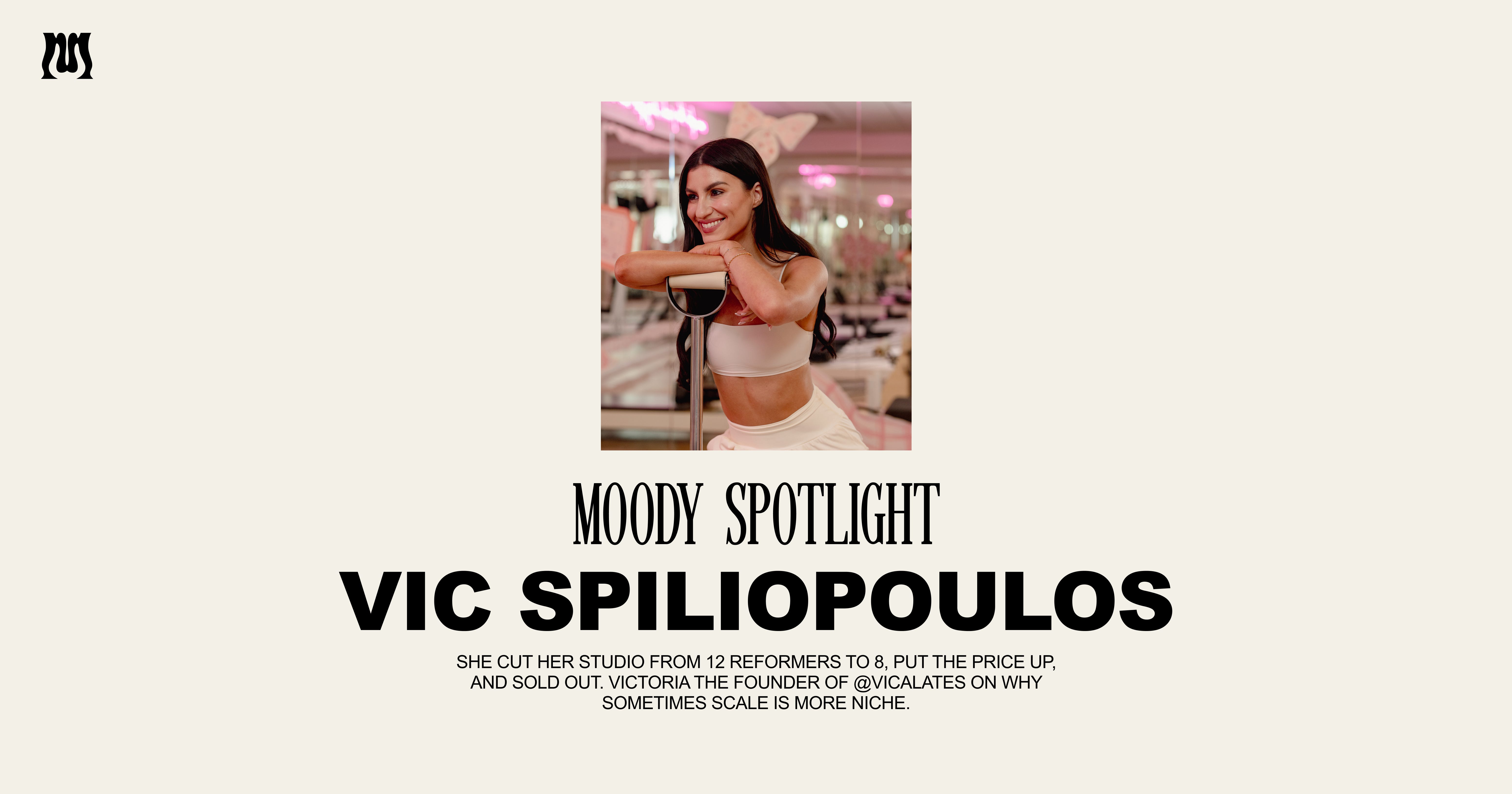
MOODY SPOTLIGHT, the interview edition. You know girl of the week, where you meet the girl. This is where we open the books: one woman, one real business decision, and the actual mechanics of how she made it. First up: Vic, founder of Vicalates.
“Reformer is dead.”
That is how Vic opens our conversation. Sitting inside her own reformer studio. Having just removed a third of her machines. Voluntarily.
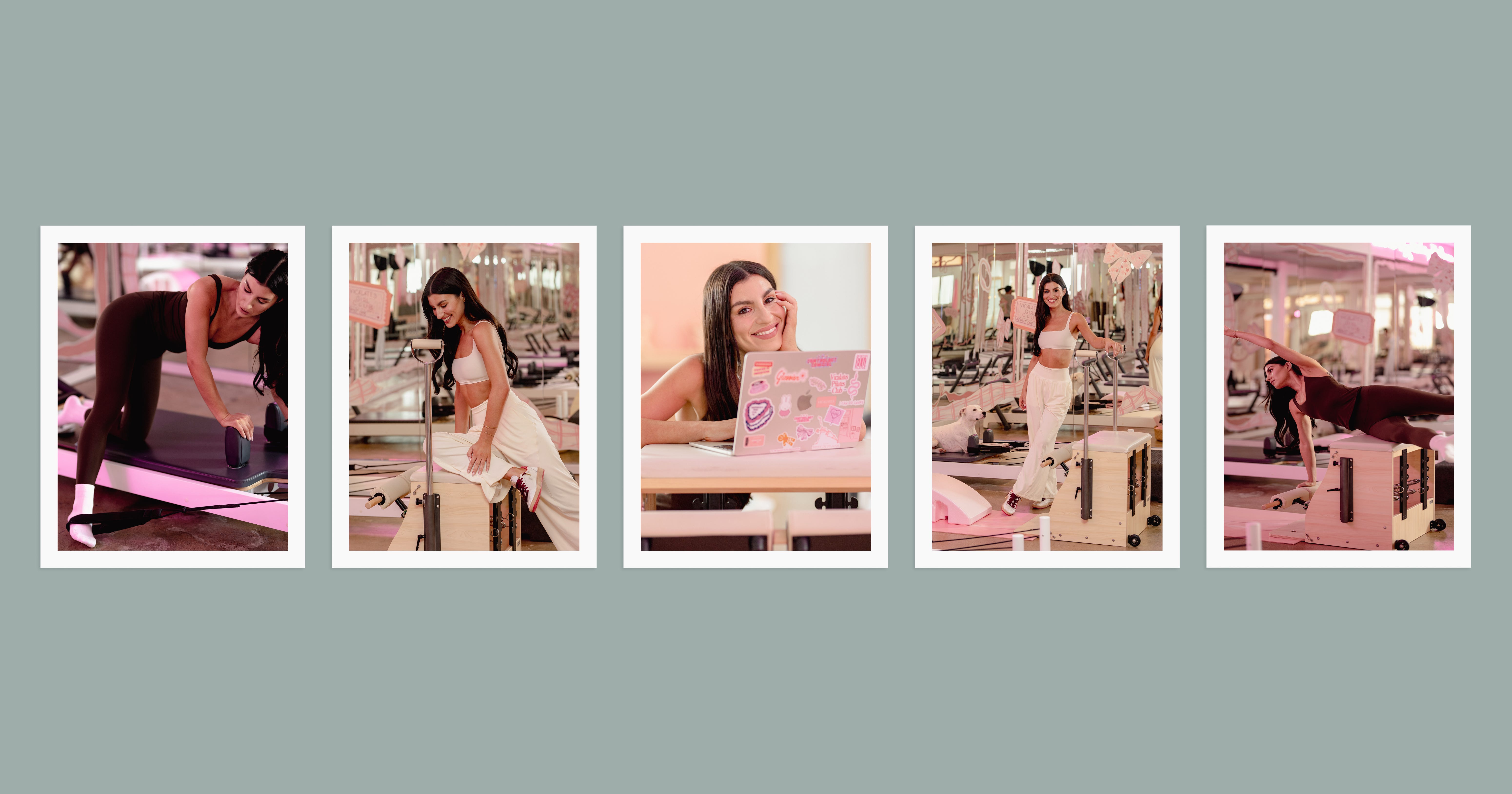
I’ve been obsessed with Vic and what she’s built at Vicalates for a long time, and I wanted her as the first guest in this series because of that exact sentence. Because while every operator in the country is cramming more beds into more rooms, Vic went from 12 reformers to 8. She shrank her class capacity by a third, lifted her casual rate to $50, and rebuilt the whole studio around what she calls pods: a reformer, a chair, a mat, and a basket of misc (her words, and the best product description I’ve heard all year).
To understand how brave that is, look at the water she’s swimming in. It’s soup. Australia now has 3,823 Pilates and yoga studios, per IBISWorld, and the count is still climbing. Pilates was the most-booked workout on ClassPass for the third year running, with bookings up 66% and the word “Pilates” searched 27 million times on the app in a single year, per the 2025 ClassPass Look Back Report. KX passed 100 studios back in 2023. Strong Pilates, Australian-born, announced this week it’s at 120+ studios across 15 countries with another 200 confirmed. I’ve walked into mega studios with 28 machines in a class. Twenty-eight. You look around and everyone is just flailing.
So the category is booming and every studio in it is fighting for the same new customer. The instinct in that moment is to defend share: go bigger, add beds, discount the intro pack.
Vic did the opposite, and she said the thing I haven’t stopped thinking about since:
“Everybody else is diluting and going bigger. Scale doesn’t necessarily mean more. Sometimes scale is more niche. You’re deeper in a niche, you can actually hone in more.”
That’s the thesis. Now the mechanics, because everyone romanticises niching down and almost nobody shows you the spreadsheet.
01 — The maths of going smaller
Here’s what Vic’s numbers were telling her. Retention was fine. Her members had stayed for years. The problem was conversion: with this much choice in the market and a premium price on the door, new customers couldn’t see why Vicalates over the studio two blocks away. When your category commoditises, “good” stops being a differentiator, because good is now the baseline everywhere.
Her answer wasn’t to discount. It was to build something you literally cannot get anywhere else: the original Pilates system, all apparatus, eight people, an instructor who actually knows your name and your dodgy left hip. Fewer spots per class, more classes on the timetable, and the unit economics lift because the product justifies the price.
The casual rate for the new classes is $50. Fifty. “We’ve had so many booked in the last week or two, and no one’s batted an eyelid.”
And the scarcity is doing quiet work too. When classes are full and hard to get into, people book more diligently and the perceived value climbs. Not exclusivity as a velvet rope. Exclusivity because it’s popular.
→ So what: when conversion stalls in a crowded market, the fix isn’t a cheaper offer. It’s a sharper one. Price is only a problem when the product is substitutable.
02 — The customer you have to fire
This is the part nobody wants to say out loud, so Vic said it immediately.
“The wrong customer is always the wrong customer. You can never convert.”
The shopper bouncing between studios on a class pass, hunting the cheapest intro offer, was never going to become a member. Building for her means diluting the product for the people who actually pay your bills. So part of the redesign was being genuinely ready to say goodbye to that customer. In Vic’s words: the girls who get it, and the girls who don’t. Go somewhere else.”
That’s the terrifying bit of niching down. It doesn’t feel like strategy, it feels like turning away revenue. But a niche is defined just as much by who it’s not for as who it is. And the customer you lose was costing you the positioning that wins the customer you want.
→ So what: your niche is defined by who you’re willing to lose. Write the list. The list is the strategy.
03 — The moat is capability
Here’s my favourite part of the whole model. To teach in Vic’s pods, an instructor has to be comprehensively trained across the full system. Mat, reformer, chair, tower, all of it. Not, as she puts it, a two-day course on the weekend. They have to program across every apparatus and deliver real feedback, class after class.
Because feedback is the actual product. “Feedback is a gift. I wouldn’t give it to you if I didn’t think you were worth it.” Vic is, by her own confession, a tough teacher. I can confirm. And it lands, because clients can read energy: they know the difference between an instructor performing corrections and one who is watching you because she cares whether you get better. One comment, “move your knee back,” and suddenly you’re being seen. Watched. Worth correcting. So many studios offer nothing personalised, and it’s not a values problem, it’s a capability problem. The instructors are green. You can’t give what you don’t have.
And this is where Vic’s story collided with mine. She told me everything new she launched this year got copied within months. Girl. Same. My content formats get lifted weekly, and tech companies have started doing tiny mics at conferences. It’s annoying for about a day, and then you remember: being copied is the tax you pay for leading. The only real response is to keep moving onto ground that’s expensive to follow you onto. A vibe can be copied by Thursday. A comprehensively trained team, a decade of craft, a founder with an actual point of view? That takes years, and most competitors won’t pay that price.
→ So what: if your edge can be screenshotted, it’s not a moat. Build the thing that requires skill to copy, not budget.
04 — The direction of travel says she’s right
One number from the research made me sit up. On ClassPass, reformer bookings grew 71% last year. Mat Pilates grew 114%. The original, machine-optional, fundamentals-first version of the method is now outgrowing the machine that made the boom. The market is already drifting back towards exactly what Vic rebuilt her studio around.
Zoom out and the wellness data rhymes: stretching bookings up 143%, meditation up 50%, massage up 42%. Vic’s predictions for the rest of the year: rest is going to have a big moment, the extreme recovery protocols are dying (“the cold plunge is out,” you heard it here first), and human connection comes back in as wellness itself.
Which reframes the whole eight-pod decision. Being seen and corrected by a skilled human, in a room small enough that she actually can, is not a nostalgic throwback. At eight people, personalisation is real. At twenty-eight, it’s theatre.
Rapid fire with Vic
Because this series comes with a rapid fire round, and nobody leaves without doing it.
What are we wearing to work out? Vic, that day: an 80s thong body set over red tights. Navy and red. Her read: the matching set era is fading. “We’re coming into texture. We want layers. Things that don’t look like workout gear.” She reckons even Lululemon is working on a whole “away from body” direction, soft and off the silhouette.
Accessories? “Obnoxious.” We are working out in your boyfriend’s Rolex. I’m wearing mine to her class because mom, I am a rich man. This is binding.
Most unhinged thing you’ve done for the studio? “I have faked some things till I’ve made it. And no one noticed. We’re here now.”
What are ambitious women doing too much of, and not enough of? “Way too much listening and talking to other people, and not enough going into their own head and doing what they want to do. Consult people you actually care about. Listen to them. But their journey is not your journey.”
What’s next in wellness? Rest. Sleep, downtime, low-key breaks. Cold plunge out, human connection in.
Where can we find you? Vicalates on IG, website to book classes in Brisbane or virtually and access our app. Personal IG.
Her rapid fire answers and her business strategy are the same answer. Everyone else’s journey is not your journey. She stopped watching what the other studios were doing and went deeper into the thing only she could do.
My read: when your category gets crowded, don’t get louder. Get harder to substitute.
The question I’m leaving you with: what’s the version of pulling four machines out of the studio in your business? The thing that looks like shrinking, and is actually concentrating?
Tell me. I read everything.
Love Brooke x
MOODY is Australia’s answer to the serendipity Americans take for granted. The room where founders, operators, corporates and creatives are in the same group chat, and it turns out they needed each other. These are the girls who get it and we are in a MOOD.
This newsletter is the highlight reel. The WhatsApp is where we actually live.
Every city, growing weekly.
loved this Brooke! it's giving 'personal disrupter' energy