

Hi divas 🤍
It’s been a month since Singapore, which is exactly the right amount of time. The recaps are out, the LinkedIn glow has faded, and what’s left is the stuff that actually stuck. That’s the version you’re getting.
Quick scene-setting for the girls who don’t live in retail: NRF is the National Retail Federation’s Big Show, the largest retail conference in the world, held in New York every January. NRF APAC is its Asia-Pacific edition, held in Singapore in early June, and it’s the biggest retail gathering in our region.
Now sit with two numbers.
New York in January: 40,000 people. Singapore in June: 11,000.
Easy to read that as the little sibling event. The satellite show. The warm-up act. It’s the exact wrong read, and the opening address said why: by 2035, Asia-Pacific overtakes North America as the world’s largest consumption region, with affluent households growing at six times the pace of the rest of the world. The region already gave the world the super-app, social commerce and Singles’ Day while the West was still A/B testing button colours.
The small room is the main event. The big room just doesn’t know it yet.
Quick bias declaration before we go on: I work at AWS, we co-hosted the Aussie delegation and the Retail Safari, and this is literally my day job. Take everything below with that context. The opinions, though, are all mine, and a few of them are not in the corporate pack.
01 — Australia finally got on the bus
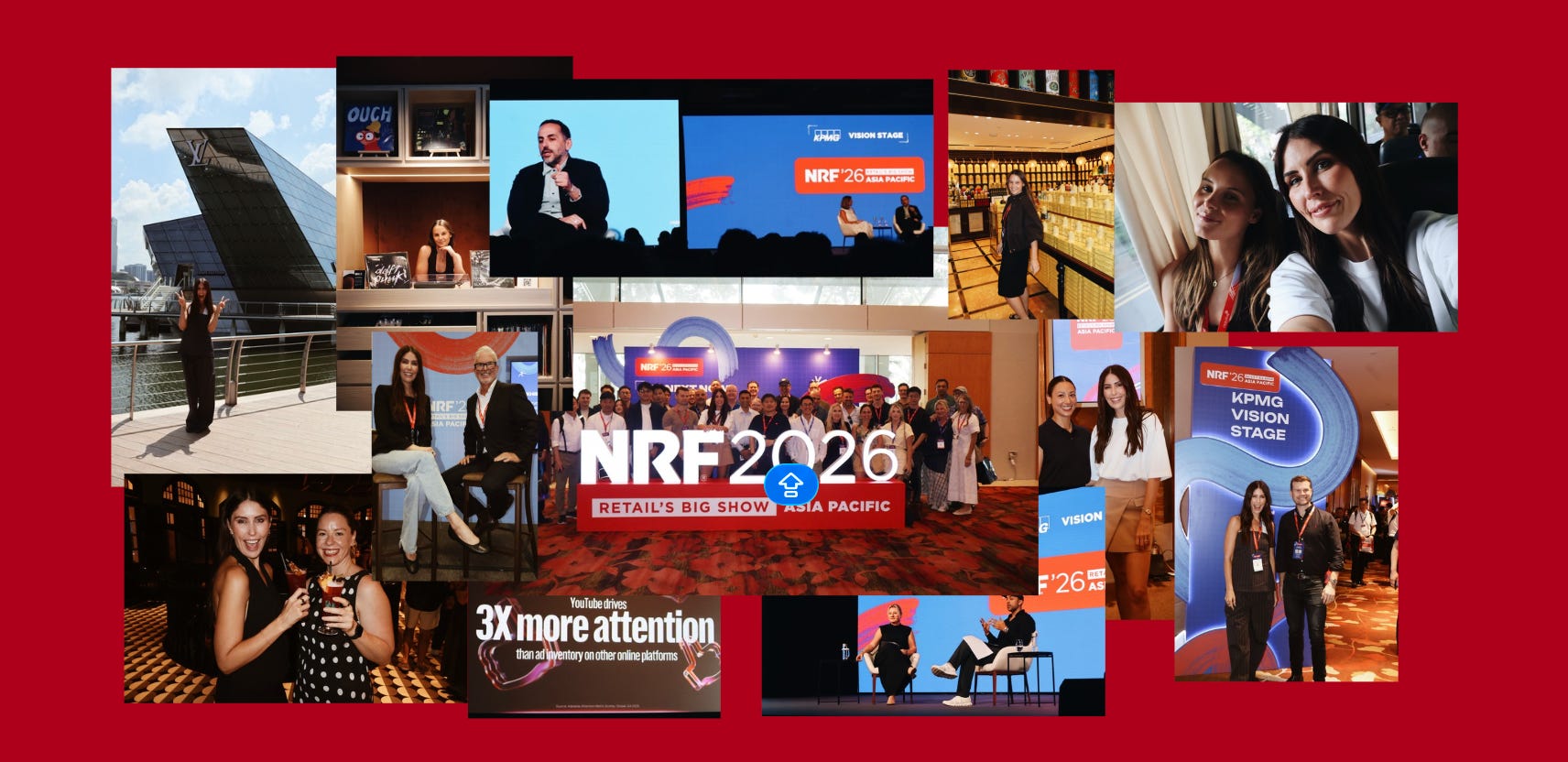
The delegation was the bit that made me proudest. Woolies, Myer, David Jones, ALDI, Wesfarmers, THE ICONIC, The Warehouse, Aspar. Australia and New Zealand’s best and brightest retailers, on a bus in Singapore, instead of in a cab downtown New York.
That matters more than it sounds. Australian retail has a default setting: when we want inspiration, we look west. US formats, US playbooks, US conferences. But the growth isn’t west. The consumption boom is north of us, the AI adoption curve is steepest north of us, and the retail formats that will eat our lunch if we ignore them are being built two time zones away, in our region, in our trading hours.
→ So what: if you’re a founder or marketer choosing where to spend your one conference budget or your one research trip this year, the maths has changed. Seoul, Singapore, Bangkok and Shanghai are the field trip now. New York is the rerun.
I’m taking my own advice: I’m doing China in September and I can NOT wait.
02 — Here’s my note
The content was strong, I want that on the record. The LVMH session with Anish Melwani was the most quoted of the week for a reason: his line that if every customer service agent ends up virtual, “the last customer service agent will work for LVMH.” As AI takes the admin, human interaction becomes the scarce, premium thing. Ten years of “human is the new luxury” talk and he made it a business model in one sentence.
His other idea is the one I want every founder in this community to sit with: the difference between demand and desire. Demand is what customers tell you they want. Desire is the emotion you create in them. “A great brand will come up with products that nobody ever asked for, that yesterday nobody had ever seen before, but today some portion of the audience can’t live without. That’s desire. That’s not demand.” You cannot survey your way to it. You read the moment, back your taste, and make the thing nobody requested. Every founder agonising over another round of customer feedback before shipping needed to hear that.
But I’ve been sitting on this one for a month and it hasn’t softened: I want Asia’s conference to be Asian.
We flew in Europe’s finest, LVMH and Kering, to a room in Singapore, and a good chunk of the agenda was a recap of what already played in New York in January. Meanwhile the most interesting retail on the planet right now is happening in China, Korea, Thailand, Indonesia, Vietnam. Olive Young, the Korean beauty retailer that every Western beauty exec is quietly obsessed with, got a small session that didn’t hit. That’s the brand I wanted an hour with. That’s the brand I flew for.
The best read of the whole week backed me up. Dr Frank Yang’s closing keynote on China was the sharpest thing on any stage: Chinese youth consumption shifting from planned to instant, shoppers trading up from price-performance to price-quality, and the whole market moving from buying goods to buying lifestyle, with emotional, self-pleasing consumption now driving growth. One keynote. I wanted a full day of that, from every hot market in the region.
The gap between what that conference was and what it could be is the same gap I wrote about after Vogue Codes. So close to extraordinary. Give me less of Europe explaining luxury to Asia and more of Asia explaining the future to everyone else.
03 — FOBO, the acronym that followed everyone home
FOMO is dead. The new condition is FOBO: the fear of better options.
KPMG’s Global Head of Consumer and Retail, Isabelle Allen, put it on the table on day one: “The new term is FOBO, the fear of better options. The risk is not just that you invest and get some things wrong. The greater risk is that you wait and fall behind, or get excluded from the party altogether.”
Nobody’s scared of missing AI anymore. They’re scared that whatever they commit to now gets outdone by something cheaper and better next month, so they wait. The tool paralysis is real: every week there’s a new model, a new agent, a new platform someone swears is the one, and freezing starts to feel like the responsible move.
By the end of the week the acronym had quietly upgraded itself into something darker: the fear of being obsolete. And I’m going to plant my flag here, because I think the second definition is the correct one. “Better options” makes waiting sound rational, like you’re a savvy shopper holding out for the sale. You’re not. There is no perfect moment coming, and the option you pick matters far less than the muscle you build using it. The experimenting you do right now, the messy pilots, the wrong first tool, the prompt that didn’t work, is the actual capability. It compounds. Sit out this window because you’re waiting for a better option and you don’t fall behind by one tool, you fall behind by every lesson the tool would have taught you. That’s not behind. That’s obsolete.
The best answer to FOBO on any stage came from FairPrice, Singapore’s biggest grocer. Their “store of tomorrow” runs about nine AI initiatives at once, and they only keep the ones that earn their place against real business metrics. Basket size. Gross margin. Not vibes.
→ So what: this applies whether you’re running a startup or a team inside a corporate. You don’t need the perfect tool. You need small, no-regret bets measured against one real number, and the discipline to kill the ones that don’t move it. The cost of a wrong bet is a lesson. The cost of no bet is your relevance.
04 — Your product data is your shopfront now
This is the section to forward to anyone with a Shopify store, a marketplace listing or a marketing budget.
I told you in the June cap table report that agentic checkout went live in Australia, with THE ICONIC, Adore Beauty and Bunnings feeding product data straight into Google. Singapore was three days of the why. Retail is handing the act of discovery over to AI. Increasingly, a shopper doesn’t search for your product; her AI agent does. And agents don’t browse. They don’t feel a vibe. They don’t look at pictures.
They read data.
Here’s the number that should scare you into action: a Mirakl study of retail websites across the region found an average product-data readiness score of 48 out of 100, with fewer than one in a hundred sites scoring above 80. Myer’s Warwick Blunt was refreshingly honest about it on stage: a dress carried only in evocative marketing copy may never be surfaced for the shopper who wants it, because the agent can’t read “effortless summer elegance.” It can read fabric, fit, occasion, size, stock and shipping speed.
Roger Dunn’s session gave the week its best line: when discovery, comparison and purchase collapse into a single AI interaction, the brand becomes metadata. His numbers were just as sharp:
→ A Google search averages 3.4 words. A prompt to ChatGPT can run to sixty. Keywords are ice cubes, uniform and mass-produced; prompts are snowflakes, layered with context. The signal is ten times richer, if your data can answer it.
→ Traffic arriving from AI assistants converts at around 11.4%, miles above paid or direct, because that shopper has already done her research.
→ Shoppers trust a retailer’s own AI tools roughly three times more than the big platforms’, and Walmart sees order values rise about a third when customers shop through its agent, Sparky. The retailer’s edge is knowing what’s actually in stock, right now, at what price. The big models don’t.
→ So what: enriching your product data is the least glamorous and highest-leverage marketing job of 2026. Structured attributes, reviews, sizing, stock, shipping. If the AI can’t read you, you don’t exist at the exact moment someone’s ready to buy. For a small brand this is the rare game where you can out-execute a department store with a spreadsheet and a weekend.
05 — The marketing money, and where it’s going
Three sessions, one uncomfortable message for anyone holding a marketing budget.
→ Les Binet, the effectiveness godfather, came with receipts: how much you invest accounts for roughly 90% of the profit marketing generates, and the efficiency of each dollar only about 10%. Since the pandemic, marketers have nudged measured ROI up a few points while actual profitability fell by more. Leaner, and delivering less. His fix: weight spend roughly 60/40 towards brand over short-term activation, and protect share of voice even when the budget conversation gets ugly. And the line to pin above your desk: big brands that imitate small brands become small brands.
→ Adrian Staiti of CAA called time on celebrity badging. Slapping a famous face on a product and calling it a campaign is dead money. Asking what a celebrity costs is, in his words, like asking how long is a piece of rope. The winners start with the story, then find the partner. One Snapdragon x Manchester United announcement did more for awareness than years of paid media.
→ Crafted’s Sarah Nesheim brought the creator maths. Don’t chase virality, manufacture word-of-mouth: activate creators by the hundreds on standardised rates, watch what resonates, then whitelist the winners and run paid under the creator’s own handle so the social proof stays intact. Lo-fi UGC at $0 to $200 a video routinely beats polished brand creative. And measure incrementality, the customers who wouldn’t otherwise have bought, not ROAS.
→ So what: the founder playbook writes itself. A few micro-creators in real relationships beat one expensive celebrity post, brand-building is an investment not a luxury, and the moment your audience feels tricked by fake or AI-made content, the trust is gone for good.
06 — The safari (hot af, worth it)
Day three we swapped the keynote stage for the streets. The Retail Safari with NORA was thirty-plus degrees, a hundred percent humidity, and we were so, so sweaty. I’d do it again tomorrow. Nothing beats seeing retail in the wild.
The stop worth your attention is New Bahru: the beautifully preserved former Nan Chiau High School reborn as a retail precinct, with more than forty independent, made-in-Singapore, mostly founder-led brands and not a single mass chain. Badminton court markings still on the floor. Every tenant chosen for fit, not for the footfall guarantee. It’s what happens when curation is the actual strategy, and it made every Australian on that bus quietly rethink what a “centre” is for.
FairPrice Finest was the other one: a supermarket with a bar in it, craft beer on tap and meals cooked from ingredients in the aisle you’re standing in. Grocery as a destination, not a chore.
And the thing I personally can’t stop thinking about: single-brand beauty stores in their full expression. Walking into one brand’s complete world is magic, and the discipline is asking what travels. The Prada Beauty spring flower market was the masterclass: the concept worked at full scale in-store and compressed down to a single gondola at the airport. That’s the test of a real retail idea. It survives shrinking.
Honest caveat for the Australian reader: plenty of this won’t copy-paste here. Singapore is six million people in 730 square kilometres; we are sprawl. The density economics that make a New Bahru or a four-visits-a-week grocery habit work are not our economics. Steal the principle, not the format. Curation, participation, hospitality woven into retail. The inspo travels even when the floor plan doesn’t.
07 — A brief intermission about a tiny mic
Sophie and I spent the breaks running around with the tiny mic, trapping executives as they came off stage for LinkedIn content, and it was unhinged behaviour that I refuse to apologise for.
Here’s the surreal bit. Twelve months of doing this across conferences and the tiny mic now gets recognised. Executives I would have died to get five minutes with were coming up to ME saying they like the content and asking to be featured. Build the thing consistently and the room starts coming to you.
And then someone gave me feedback that stung because it was true: “You’re a brilliant journalist in the making. However, you parrot what other people say. Be more opinionated.”
Girl. Noted.
This is the magic of building a personal brand, and why I’ll keep telling every one of you to start. Jobs change, companies restructure, titles get taken off you. The brand is the only thing you take with you. And apparently mine now comes with feedback, which means it’s working.
Where this leaves us
Every stat from the week points the same direction. The consumption growth is in Asia. The AI adoption curve is steepest in Asia. The retail formats worth studying are being built in Asia. And the biggest retail conference in our region just put Australia’s entire retail leadership on a bus to go look at it, then filled half the stage time with Europe and New York.
Both things can be true. The event was excellent. The event is also one brave agenda away from being the most important retail gathering in the world.
My read: Asia was never coming. It’s been here the whole time, and the only thing that was ever west was our attention.
So: when did you last pay attention to what’s happening in APAC for inspiration instead of America? Reply, I want to know.
Brooke x
Aussie Angels is Australia’s answer to the serendipity Americans take for granted. The room where founders, operators, corporates and creatives are in the same group chat, and it turns out they needed each other. These are the girls who get it.
I loveee your writing Brooke. Keep it up x
Damn right they're coming up to you